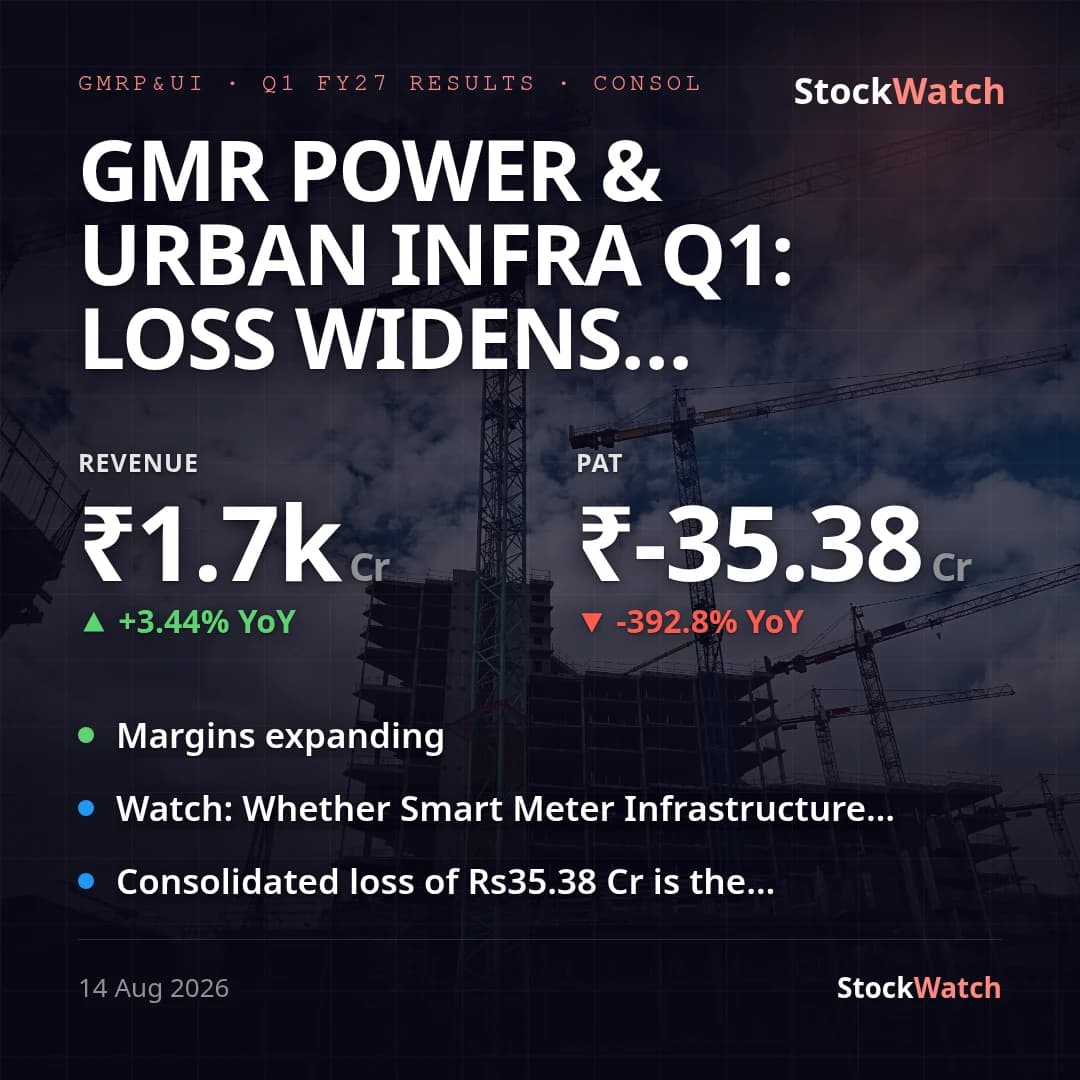
GMR Power & Urban Infra Q1: loss widens to ₹41 Cr YoY, skewed by prior-year one-off gain
GMR Power and Urban Infra's consolidated (primary) numbers for the quarter ended June 30, 2026 show revenue from operations of Rs1,705.18 Cr, up 3.4% YoY but down 14.9% QoQ, and a net loss of Rs35.38 Cr for the period (Rs41.48 Cr attributable to shareholders, EPS -Rs0.53). On the surface the YoY comparison looks sharply worse -- last year's Rs7.18 Cr loss has become a Rs35.38 Cr loss, a headline deterioration of roughly 390%. But that year-ago quarter (Q1 FY26) carried a one-off consolidated exceptional gain of Rs65.73 Cr (reversal of payables/receivables under note 7); this quarter has none. Stripping that one-off out, the adjusted year-ago loss was closer to Rs73 Cr, meaning the underlying loss has actually narrowed by roughly half YoY, not widened four-fold. QoQ the improvement is unambiguous: the loss shrank from Rs113.56 Cr in Q4 FY26 to Rs35.38 Cr.
The margin bridge is mixed but net positive on an adjusted basis. EBITDA margin (EBITDA/revenue from operations) expanded to ~29.2% from ~28.3% YoY and ~26.1% (Q4-basis) QoQ, and finance costs fell 27.8% YoY and 19% QoQ (Rs440.9 Cr -> Rs318.1 Cr), consistent with continued deleveraging. Net profit margin (PAT/total income) was -2.02% versus -0.40% YoY and -5.49% QoQ per our records -- worse YoY on a raw basis purely because of the base-effect one-off described above. Segment-wise, Power (the largest segment, ~97% of total segment results) was stable at Rs294.5 Cr, roughly flat both YoY and QoQ, with underlying subsidiaries GMR Warora Energy (Rs76.19 Cr PAT) and GMR Kamalanga Energy (Rs97.02 Cr PAT) both profitable in the quarter per the filing's related-party notes. Smart Meter Infrastructure, however, swung to a Rs4.80 Cr segment loss from a Rs64.08 Cr profit in Q4 and a Rs16.86 Cr profit a year ago, even as its revenue grew 22% YoY -- its revenue nearly halved QoQ (Rs512.43 Cr to Rs224.52 Cr), pointing to billing/execution lumpiness typical of the DBFOOT model rather than a structural issue. A Rs7.80 Cr loss from equity-accounted investments (GMR Rajahmundry Energy and joint ventures) versus a Rs0.18 Cr gain YoY was a smaller additional drag.
We found no analyst consensus estimates or brokerage previews specifically for this quarter (vsStreet: unknown), and the company has no formal prior guidance on record in our database or turned up via web search (vsGuidance: unknown) -- so there is no beat/miss framing to apply here. The quarter's most consequential corporate action was concurrent with the results: the Board approved an enabling resolution to raise up to Rs3,000 Cr via QIP, NCDs, warrants and/or FCCBs, underscoring that the Rs318 Cr quarterly finance-cost load remains the single biggest swing factor between an operating profit and a net loss. Litigation remains a live overhang but not a near-term cash item: the GIL-SIL JV's Rs2,828.75 Cr DFCC arbitration claims (of which Rs506.14 Cr is already booked as unbilled revenue) continue through cross-examination hearings in late August 2026, and GWEL/GKEL's combined receivable and valuation exposures tied to MSEDCL and GRIDCO disputes remain unresolved but auditor-reviewed as adequately provided for.