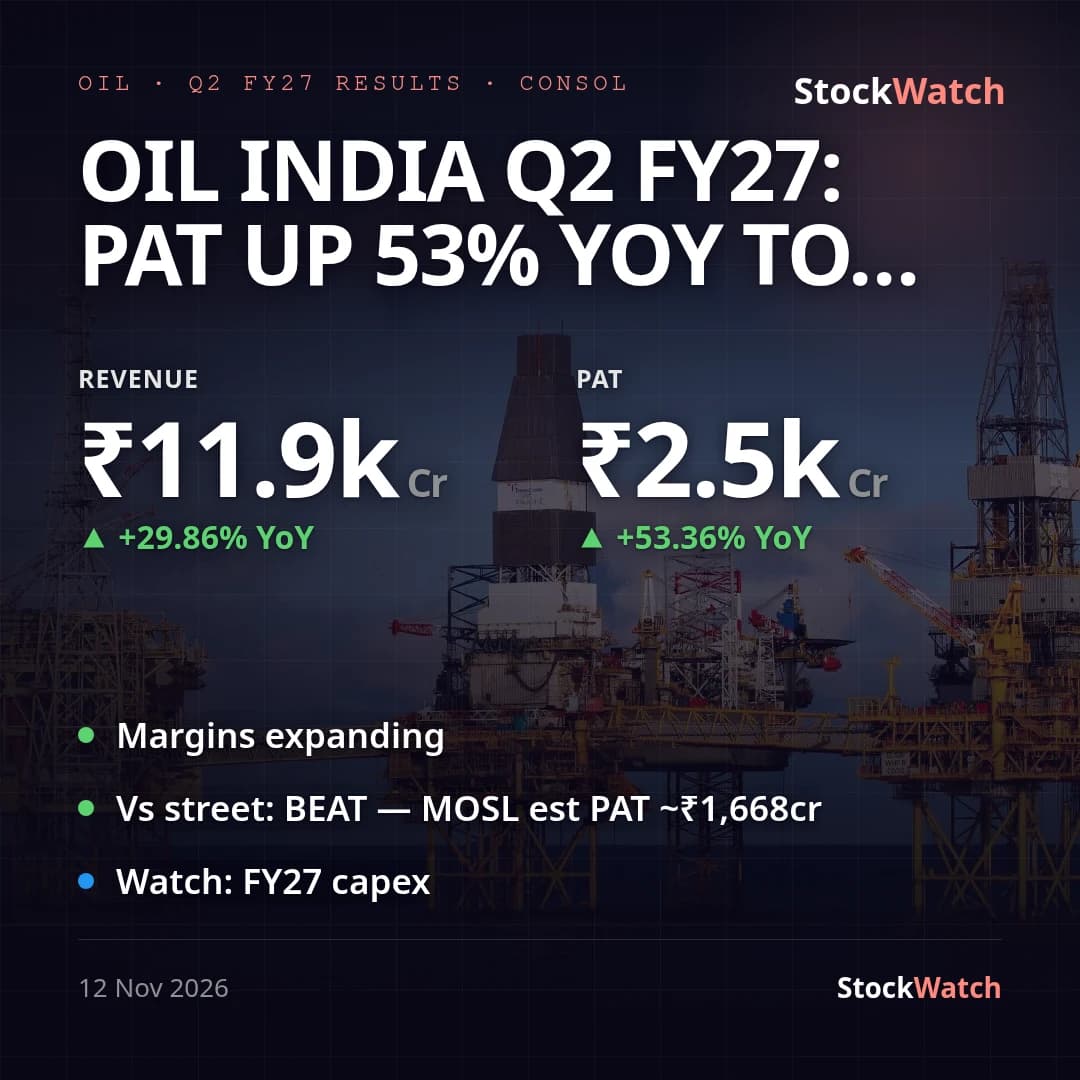
Oil India Q2 FY27: PAT up 53% YoY to ₹2,521 Cr (consolidated), down 37% QoQ off record Q1
Oil India's consolidated PAT came in at ₹2,520.87 Cr for the September 2026 quarter, up 53.4% from ₹1,643.81 Cr a year ago, on consolidated revenue of ₹11,914.80 Cr (+29.9% YoY from ₹9,175.41 Cr). Standalone PAT was ₹2,259.42 Cr (EPS ₹13.89) against consolidated EPS of ₹14.19. Sequentially, both lines eased — PAT down 37.4% and revenue down 7.5% — but that is a drop from Q1 FY27's unusually strong ₹4,026.83 Cr PAT / ₹12,886.27 Cr revenue base, not a deterioration; per the hard rule that YoY carries the verdict here, this is a strong print. No exceptional items appear in either the standalone or consolidated statement this quarter, so the YoY comparison is clean.
Margins expanded YoY but compressed QoQ: net profit margin was 21.16% versus 16.96% a year ago (consolidated disclosure table) but down from Q1's 30.42%; operating margin was 26.93% versus 25.10% YoY but down from Q1's 44.95%. The segment data shows the YoY profit growth was concentrated in Crude Oil — segment PBT of ₹2,465.29 Cr versus ₹902.59 Cr a year ago, roughly 2.7x, almost entirely a realisation-driven move. Natural Gas PBT was roughly flat YoY (₹304.66 Cr vs ₹318.88 Cr) and Refinery Products (Numaligarh Refinery) PBT was also roughly flat (₹861.78 Cr vs ₹839.44 Cr) even as refinery revenue grew 24% YoY to ₹7,990.85 Cr, implying higher feedstock/input costs ate into the refining margin on higher throughput.
On Street expectations, Motilal Oswal had modelled PAT near ₹1,668 Cr for the quarter; the actual consolidated print beat that by roughly 51%. MOSL also flagged EBITDA running about 11% below its estimate, tied to gas sales of 0.65 bcm against its 0.74 bcm forecast — a volume miss sitting inside a price-driven profit beat. No press release accompanied this filing, so management's own characterisation of the quarter is limited to the board-outcome letter; the prior concall (12 August 2026) struck a confident, cautiously-optimistic tone consistent with this profit beat, though the softer gas volume is a point of friction with that framing, and isn't independently confirmable from the P&L alone. Capex is the other concrete flag: consolidated H1 FY27 capex (exploration/development plus other capital expenditure) totalled roughly ₹8,009.64 Cr against a full-year FY27 budget of ₹8,600 Cr — already about 93% utilised at the half-year mark.
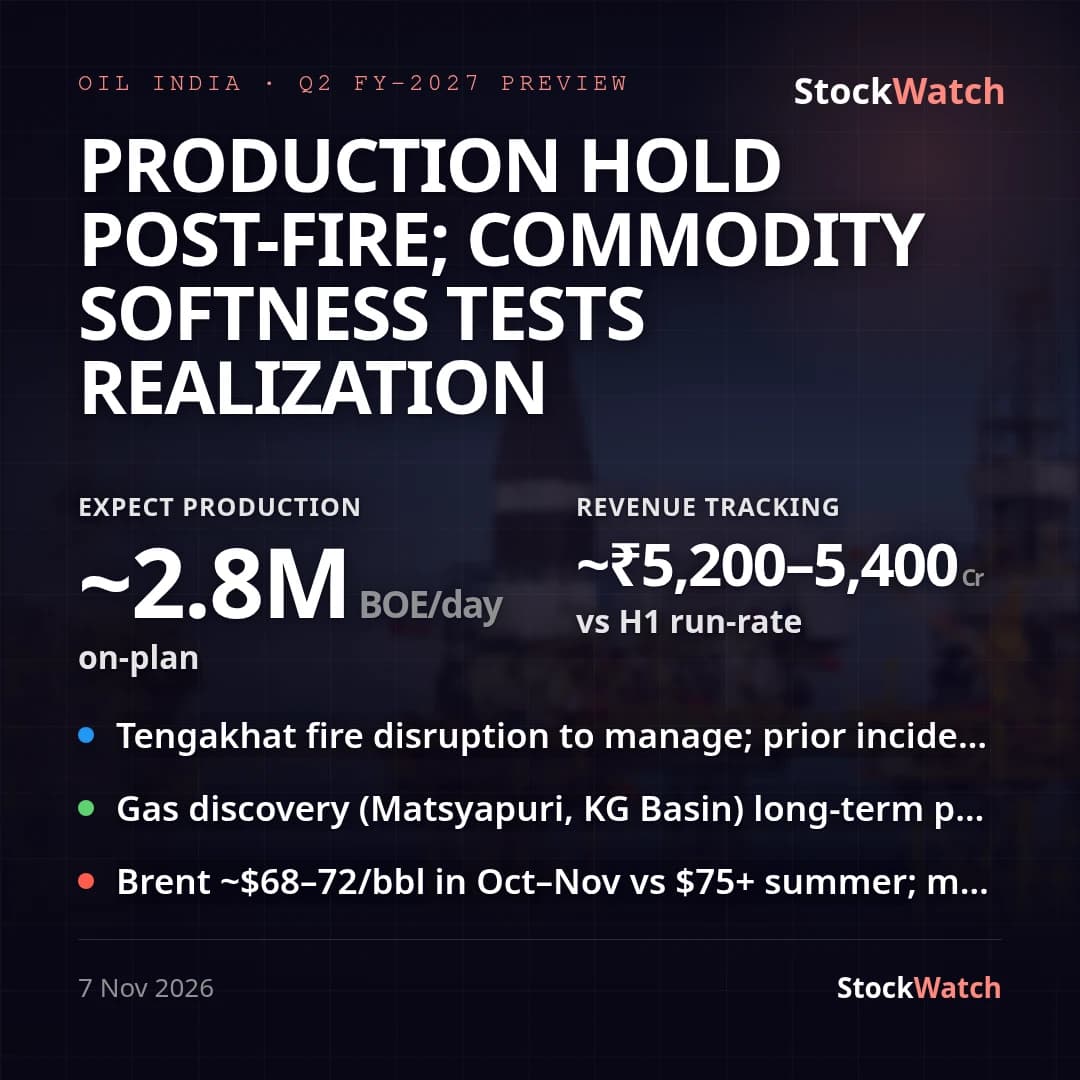
The same board meeting approved an interim dividend of ₹7 per share (record date 20 November 2026). The quarter's other news flow — a KG Basin gas discovery (23 October) and a new CBM block RSC (18 October) — points to longer-dated exploration upside but falls after the 30 September cut-off and isn't reflected in these numbers; the Tengakhat fire (6 November), which killed one worker and injured six, is similarly outside this reporting period but will be a safety and operational item to track into Q3. The next print should clarify whether gas volumes recover toward management's FY28 (3.8 BCM) trajectory, whether FY27 capex guidance is revised beyond ₹8,600 Cr, and the initial contribution from NRL's CDU/VDU unit guided to commission around October-November 2026.