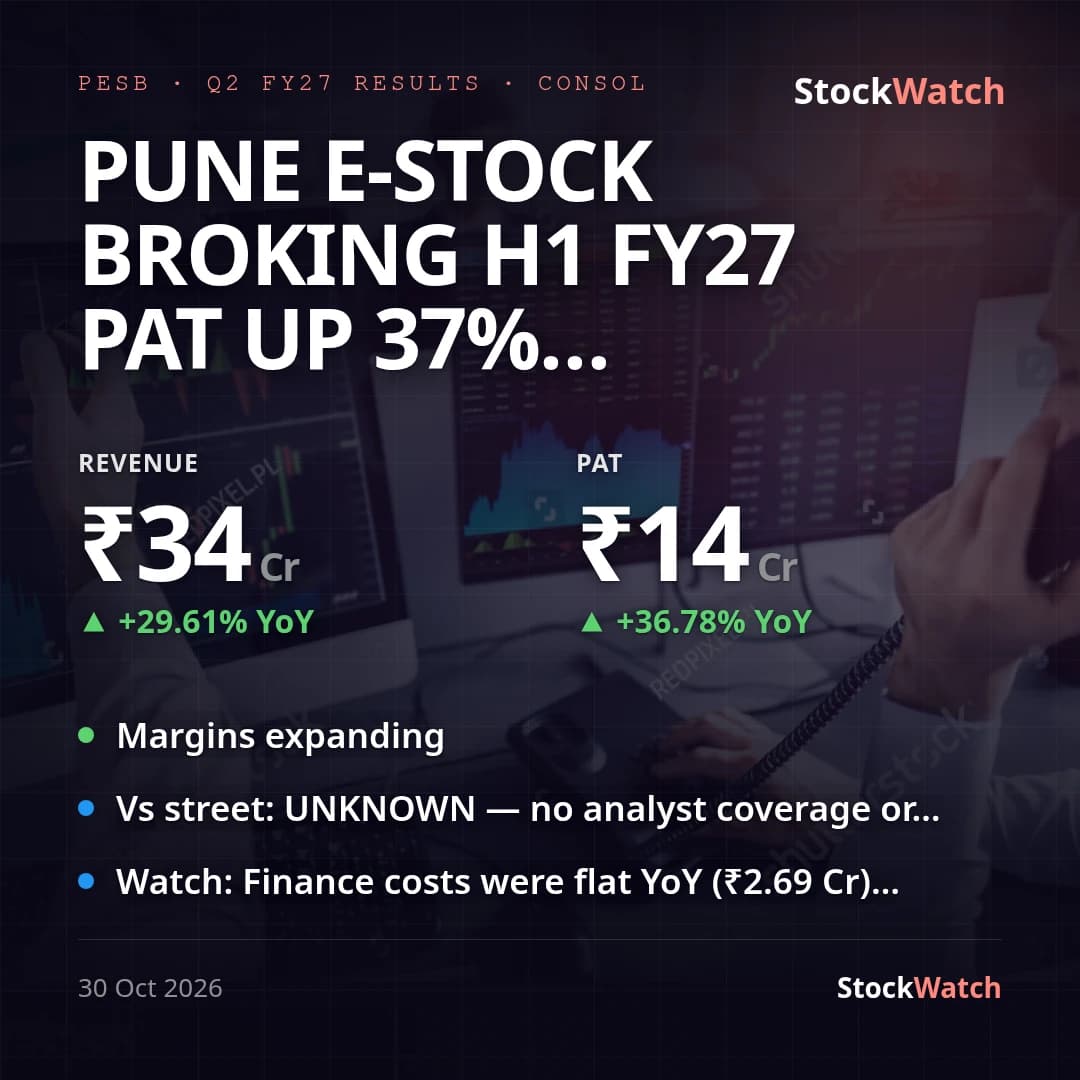
Pune E-Stock Broking's consolidated results for the half year ended 30 September 2026 (its reporting cadence under Reg 33/52(4), tracked in our system as Q2 FY27) show revenue from operations of ₹34.20 Cr, up 29.6% YoY from ₹26.39 Cr, and net profit for the period of ₹14.27 Cr, up 36.8% YoY from ₹10.44 Cr (₹14.09 Cr, +38.0% YoY, attributable to owners after ₹0.18 Cr of minority interest). There were no exceptional items in either period, so the growth is clean rather than one-off-driven.
Margins expanded on operating leverage: total income grew 29.9% to ₹43.82 Cr while total expenses rose a slower 23.8% to ₹24.77 Cr, lifting net profit margin to 32.6% of total income from 30.9% a year ago. Employee benefits expense rose fastest (+43.2% YoY to ₹3.95 Cr) as the broker added staff, other expenses grew 25.9% to ₹17.59 Cr, while finance costs were flat at ₹2.69 Cr even as short-term borrowings climbed to ₹65.09 Cr from ₹52.21 Cr at FY26-end — suggesting most of the incremental debt was drawn late in the half and will show up more fully in H2 finance costs.
Standalone PAT grew faster, +43.3% YoY to ₹13.38 Cr, than the consolidated owners' figure (+38.0%) — the gap traces to two subsidiaries (Pune Finvest, Pune E-Stock Broking IFSC) and a joint venture, which together added only ₹1.78 Cr of combined profit on ₹30.4 Cr of assets per the auditor's other-matters note, plus the ₹0.18 Cr minority-interest charge. The company also strengthened its capital base during the half, allotting 18 lakh equity shares at a ₹161 premium and 16 lakh convertible warrants at ₹234 on a preferential basis, lifting consolidated shareholders' funds to ₹220.1 Cr from ₹175.1 Cr at FY26-end; a ₹1/share final FY26 dividend was also paid. Separately, the company was fined ₹3 lakh (Aug 28, 2026) for delayed trading approval and shareholders approved director appointments (Sep 11, 2026) — routine governance items unrelated to the P&L.
Management issued no press release with this filing and has no prior guidance on record in our database; a web search for Q2/H1 FY27 previews found no analyst coverage or consensus estimates for this micro-cap broker, so the print cannot be benchmarked against the Street. Days after this half-year close, the board approved raising ₹50 Cr via NCDs (Oct 5, 2026) — likely to fund further balance-sheet growth. With short-term borrowings already up sharply at period-end and finance costs flat only because the draw was late, H2 FY27 finance costs and the use of the NCD proceeds are the clearest forward markers from this result.