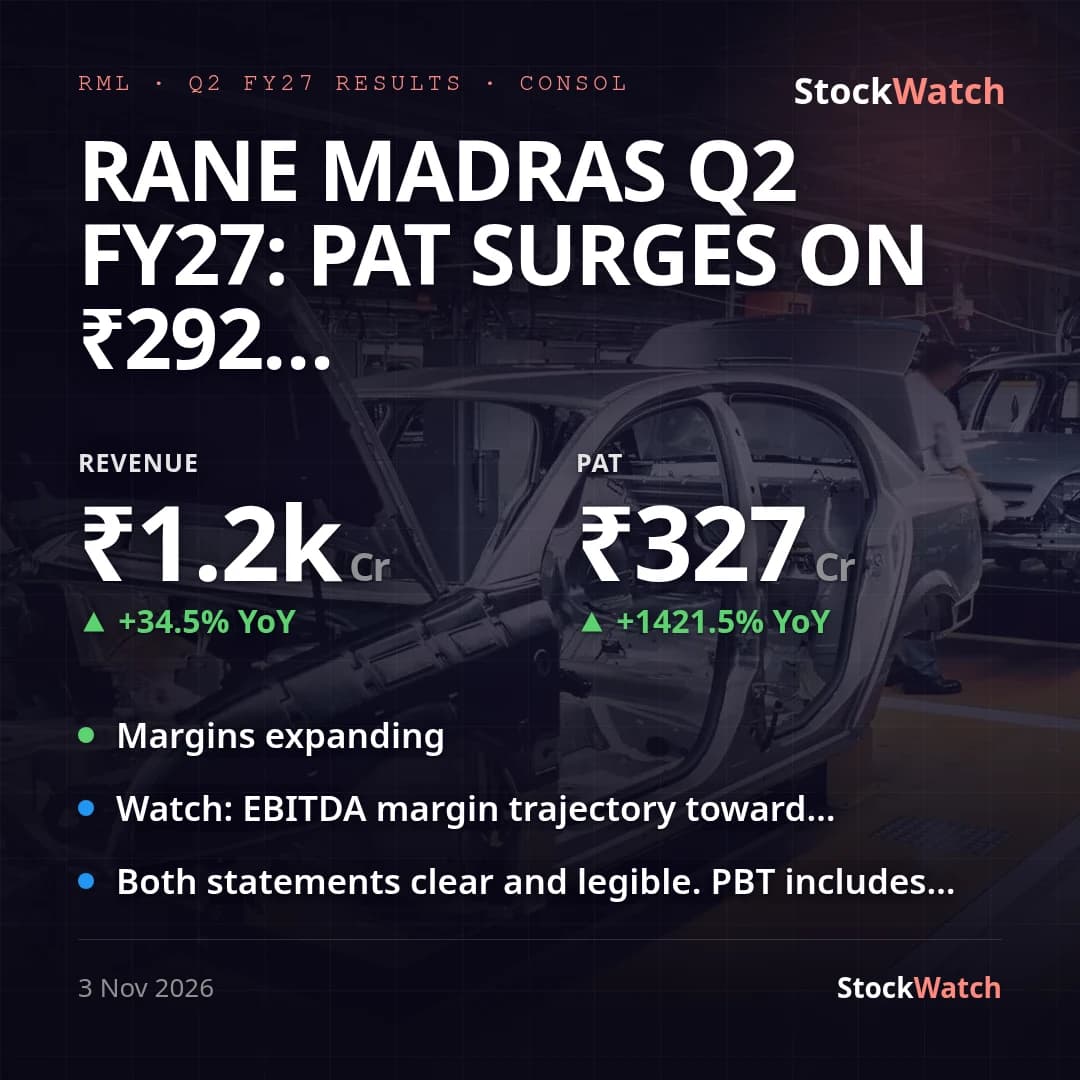
Rane Madras Q2 FY27: PAT surges on ₹292 Cr land-sale gain; underlying profit up ~61% YoY
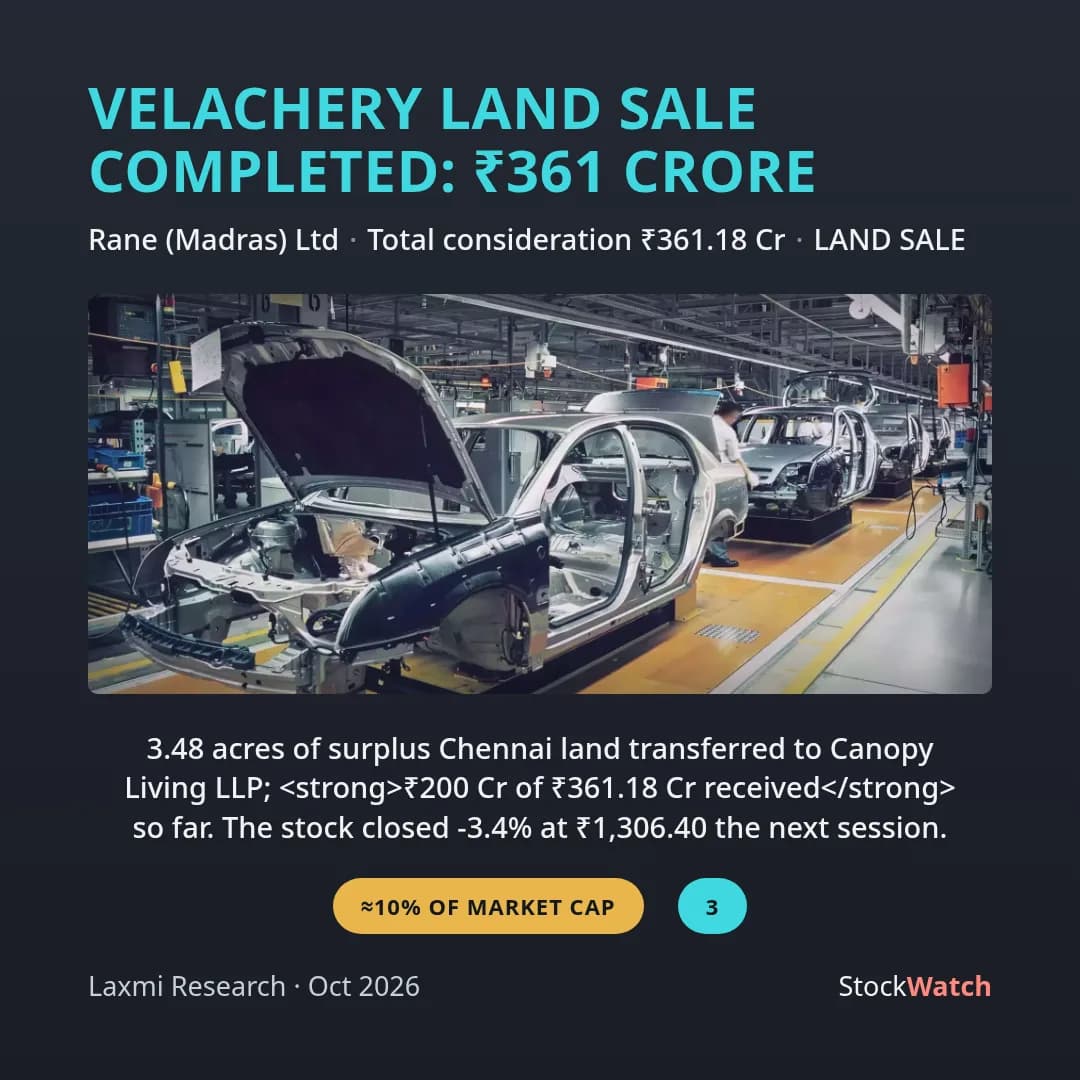
Rane (Madras)'s consolidated PAT for Q2 FY27 came in at ₹326.7 Cr, up 1,421.5% YoY from ₹21.5 Cr — but the headline is almost entirely a one-off: the company booked a ₹339.65 Cr pre-tax exceptional gain (₹341.13 Cr on the sale of 3.48 acres of land at Velachery, Chennai to Canopy Living LLP for ₹361.18 Cr, net of ₹1.48 Cr stamp duty tied to the Hindustan Composites Friction Business acquisition), which the company itself flags as a ₹292.1 Cr net-of-tax gain. Stripping that out, underlying PAT was closer to ₹34.6 Cr against ₹21.5 Cr a year ago — adjusted growth of roughly 61% YoY, a far steadier picture than the reported four-figure jump. Standalone PAT of ₹328.7 Cr tracks the consolidated number closely, confirming the one-off dominates both bases.
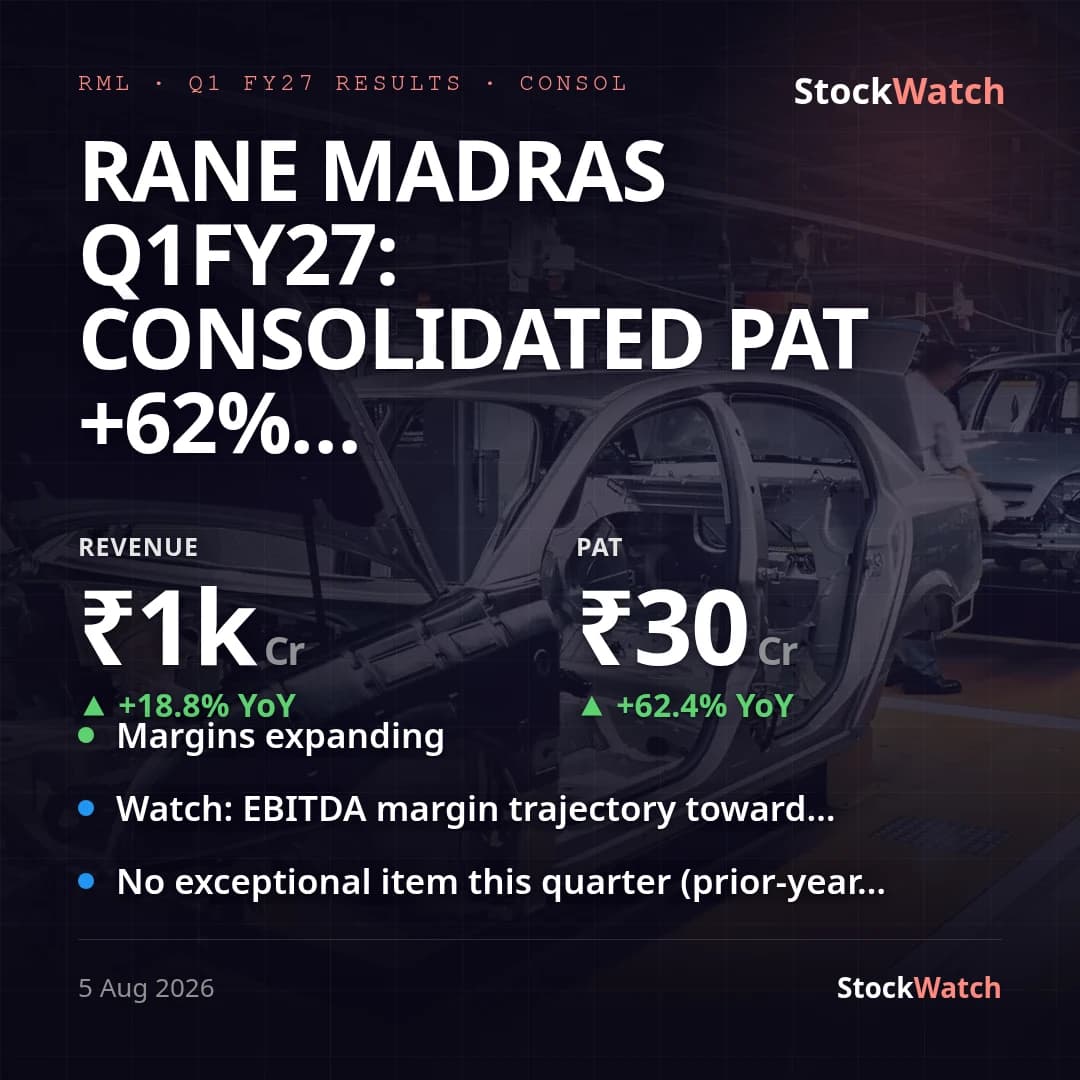
Revenue grew a genuine 34.5% YoY to ₹1,242.3 Cr (+18.8% QoQ), though part of this is inorganic: the Friction Business of Hindustan Composites, acquired for a ₹365.72 Cr slump-sale consideration, has been consolidated only from August 20, 2026. Growth was broad-based even so — domestic OE sales rose 31% on higher vehicle-segment offtake, international sales jumped 57% on steering-product demand, and aftermarket grew 11%. EBITDA rose 37.7% YoY to ₹114.1 Cr, with margin up modestly to 9.2% from 9.0% YoY and from 8.3% in Q1 FY27, as cost management and favourable forex offset higher raw-material costs — the squeeze showed up mainly in cost of materials consumed, which rose 40.6% YoY, faster than revenue.
Management's FY27 guidance from the May 2026 concall targeted double-digit EBITDA margins, a debt-to-equity reduction to 0.5x, and continued export strength; the quarter is mixed against that bar. The margin trajectory (9.2%) is improving but still short of the double-digit target. Exports delivered on the guided strength, up 57% YoY. But leverage moved the wrong way: consolidated debt-to-equity rose to roughly 0.96x (borrowings of ₹1,025 Cr against shareholders' funds of ₹1,064 Cr as of September 30, 2026, versus ₹750.6 Cr equity and lower debt at March 2026), a direct consequence of funding the HCL Friction acquisition and higher capex (H1 FY27 capex ran about ₹50 Cr above H1 FY26) rather than a sign of weaker execution. No consensus analyst estimates for this quarter turned up in public previews — RML carries limited formal sell-side coverage — so the print cannot be benchmarked against a street number; management gives no formal quarterly guidance either, only the qualitative FY27 framework from the last call.
The quarter also saw new order intake (LTV) of ₹614 Cr, following an exceptional ₹2,040 Cr booked in Q1 FY27, and confirms the Friction Business integration is now live in the numbers. Going into Q3, the markers to watch are whether EBITDA margin continues closing the gap to double digits, whether leverage begins reversing as the company has signalled, and how much of the Friction Business's own margin profile shows up over a full quarter of consolidation.