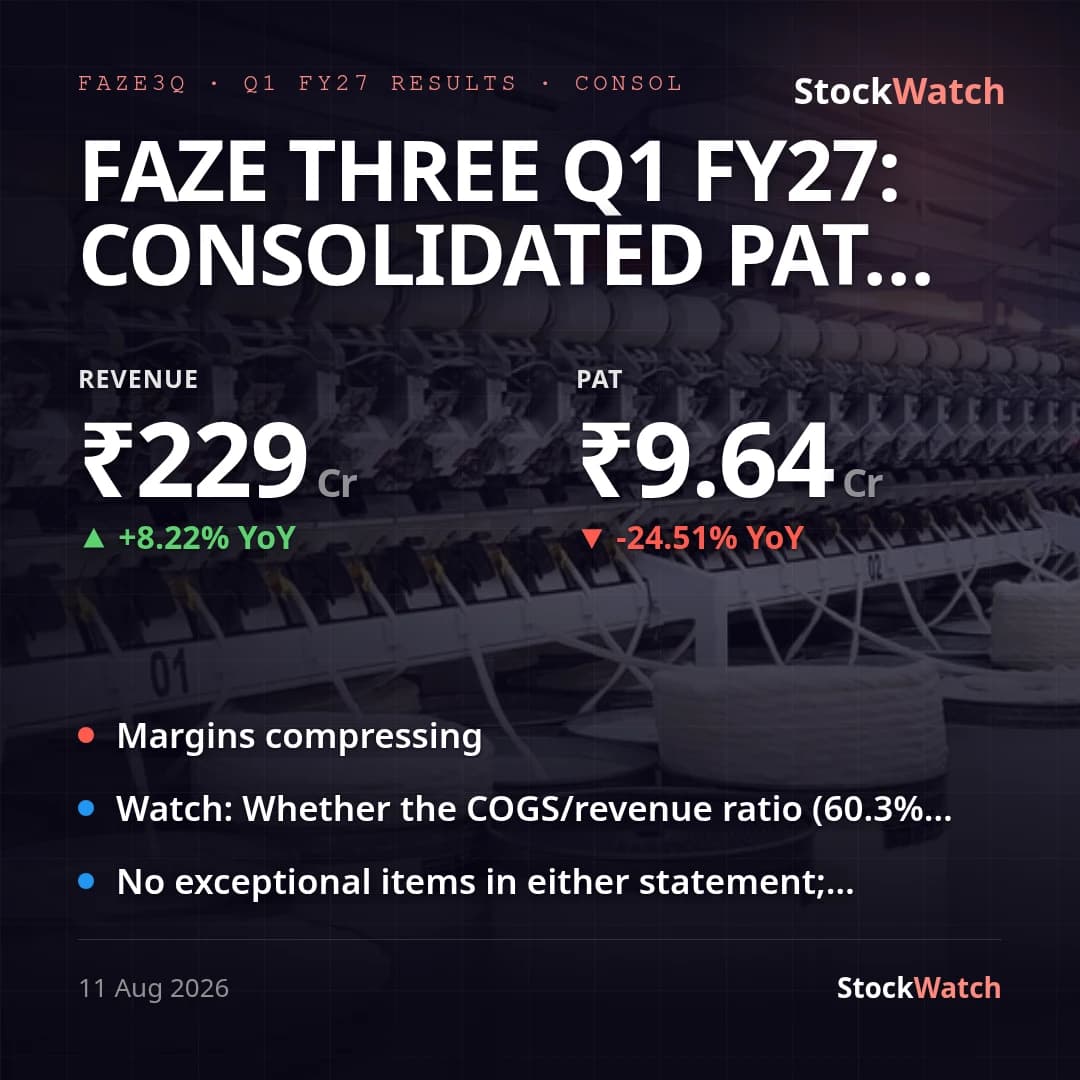
Faze Three Q1 FY27: consolidated PAT falls 24% YoY to ₹9.64 Cr on margin compression
Faze Three's Q1 FY27 (quarter ended June 30, 2026) consolidated profit fell 24.5% YoY to ₹9.64 Cr on revenue of ₹229.39 Cr, up 8.2% YoY — topline growth that did not translate into bottom-line growth. There is no formal management guidance on record for this quarter, and no analyst consensus or street estimate could be located for this small-cap exporter, so the print cannot be benchmarked against either; it is assessed purely on its own YoY and QoQ trend.
The shortfall sits in margins. Cost of materials consumed rose to 60.3% of consolidated revenue from 57.9% a year ago, pointing to raw-material cost inflation that outpaced pricing pass-through. Operating profitability (EBITDA before other income, as a % of revenue) fell to 9.32% from 11.63% in Q1 FY26 and 12.26% in Q4 FY26. Finance costs added to the squeeze, up 34.6% YoY to ₹5.64 Cr, and the effective tax rate climbed to 27.9% from 25.4% — together pulling net margin down to 4.20% from 5.92% a year ago and 6.99% last quarter. On a standalone basis the decline is sharper still (PAT -31.3% YoY to ₹8.77 Cr on revenue +4.0% YoY to ₹212.84 Cr), implying the Group's subsidiaries were, on net, accretive to consolidated profit this quarter even though auditors flag one unreviewed subsidiary posted a ₹2.10 Cr net loss for the period.
Sequentially, revenue is down 17.2% and PAT down 50.8% from Q4 FY26, but Q1 (April-June) is typically the softer season for this home-textile exporter relative to Q4, so the QoQ slide should not be read as fresh deterioration — the YoY comparison is the more meaningful read. Among the quarter's developments, the company received PLI Scheme approval for MMF (man-made fibre) and technical textiles on July 1, 2026, a potential incentive/capacity tailwind not yet reflected in these numbers; it also granted 3.31 lakh ESOPs during the quarter and saw an independent director's tenure conclude. No management press release accompanying the results was available to cross-check the company's own framing.
Going forward, the key markers are whether the raw-material cost ratio and finance costs normalise back toward FY26 levels, and whether the newly approved PLI scheme shows up as disclosed capex or volume gains in coming quarters.