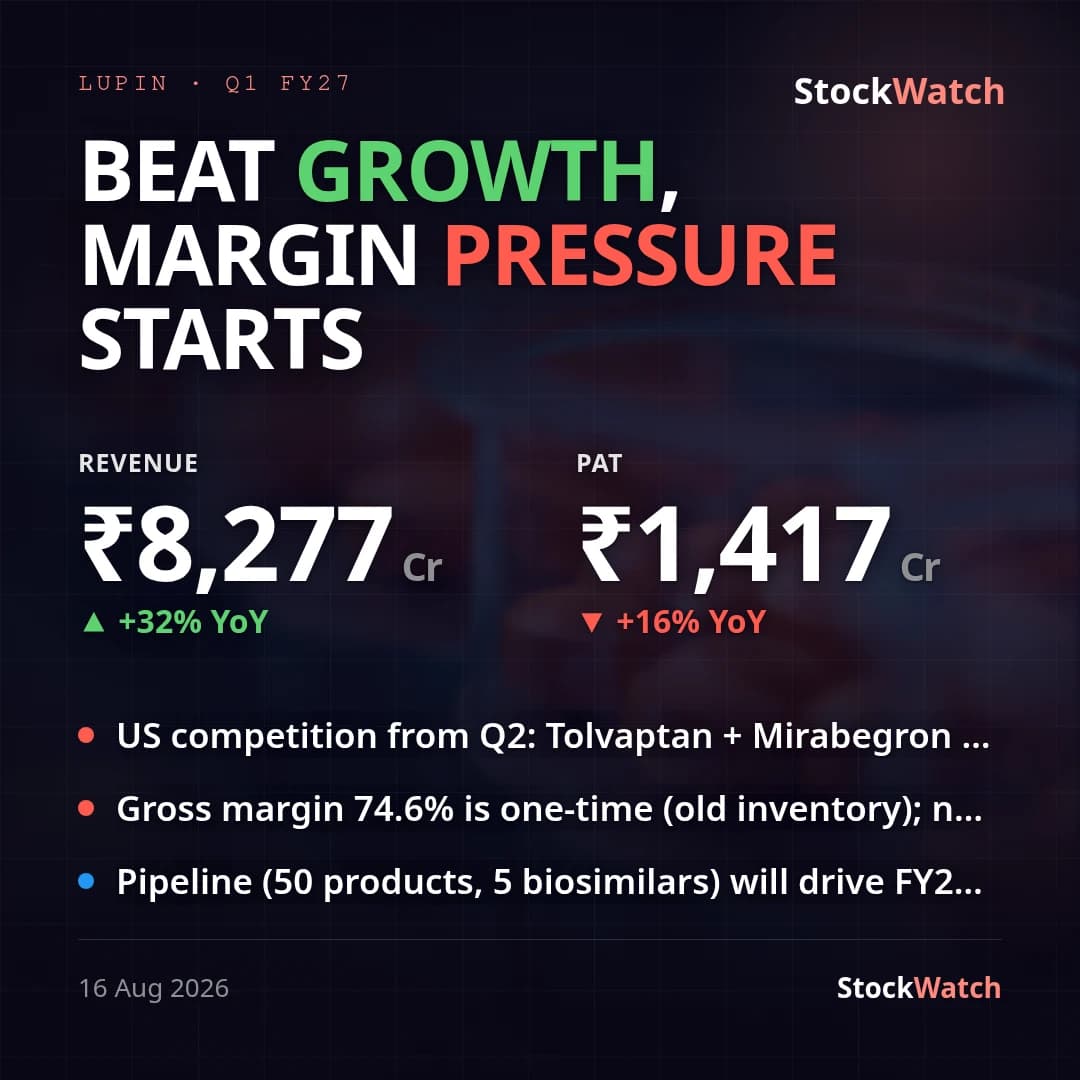
Lupin's consolidated Q1 FY27 revenue came in at ₹8,276.89 Cr, up 32.0% YoY and 10.7% QoQ, comfortably ahead of Street estimates that had clustered around ₹6,300-7,096 Cr (Uniresearch's 37-analyst consensus pegged it at ₹6,632 Cr). Consolidated PBT of ₹2,017.36 Cr grew a sharper 42.5% YoY (+4.6% QoQ), while consolidated PAT (total, including minority interest) of ₹1,416.98 Cr rose a more modest 16.0% YoY but slipped 3.5% QoQ — still beating the Street's PAT estimate range of ₹927-1,179 Cr (Uniresearch: ₹1,053 Cr).
The gap between PBT growth (+42.5%) and PAT growth (+16.0%) is a tax-base effect, not an operating slip: Q1 FY26's effective tax rate was an unusually low 13.7% (aided by a ₹296.8 Cr deferred-tax credit that quarter), versus a normalized 29.8% this quarter and 23.8% last quarter. Reported net margin consequently compresses to 17.12% from 19.24% YoY and 19.29% QoQ, even though the underlying EBITDA margin (computed consistently as PBT plus finance cost and depreciation, less other income, over operating revenue) actually improves to roughly 29.6% from 27.55% a year ago. Consolidated results also reflect the VISUfarma B.V. acquisition (concluded April 1, 2026, Euro 192.8 million/₹20,902.7 Cr consideration) consolidating for the first time, with acquisition costs booked in other expenses; per the auditors' note, a set of 17 unreviewed overseas subsidiaries posted a combined net loss of ₹241.1 Cr this quarter, which is the main reason standalone PAT (₹2,714.60 Cr) runs far ahead of consolidated PAT (₹1,416.98 Cr) — a materially different picture between the two bases that readers should note.
Against management's FY27 guidance from the last call — high-single-digit revenue growth with EBITDA margins normalizing to around 25% from FY26's record levels, amid new competition for Tolvaptan and Mirabegron — the print is broadly on track: margins are moving down toward the guided level (29.6% EBITDA margin this quarter, still above the ~25% full-year target, consistent with a gradual normalization), while the outsized 32% YoY revenue growth is aided by the VISUfarma consolidation rather than being a clean organic beat of the high-single-digit guide. No standalone press release or management commentary on the print was available at the time of this analysis; the earnings call is scheduled for August 7. The quarter's other developments — USFDA approvals for Diazepam Injection USP and Sugammadex Injection (announced July 31, 2026) and the subsidiary's licensing of oncology programs for an 82.2% stake in Kaveri Therapeutics (announced July 21, 2026) — sit alongside management's stated strategy of expanding the complex-product and biosimilar portfolio, though neither is large enough to show up in this quarter's reported numbers.
Going into Q2 FY27, the read-through is: PBT and revenue momentum both beat Street by a wide margin, but the tax-rate base effect and overseas-subsidiary losses mean consolidated PAT growth understates the operating improvement. The next checkpoints are whether the EBITDA margin continues its guided glide path toward ~25% for the full year, how the newly consolidated VISUfarma business and other loss-making overseas units trend, and the US segment's exposure to Tolvaptan/Mirabegron competition that management flagged as a FY27 headwind.