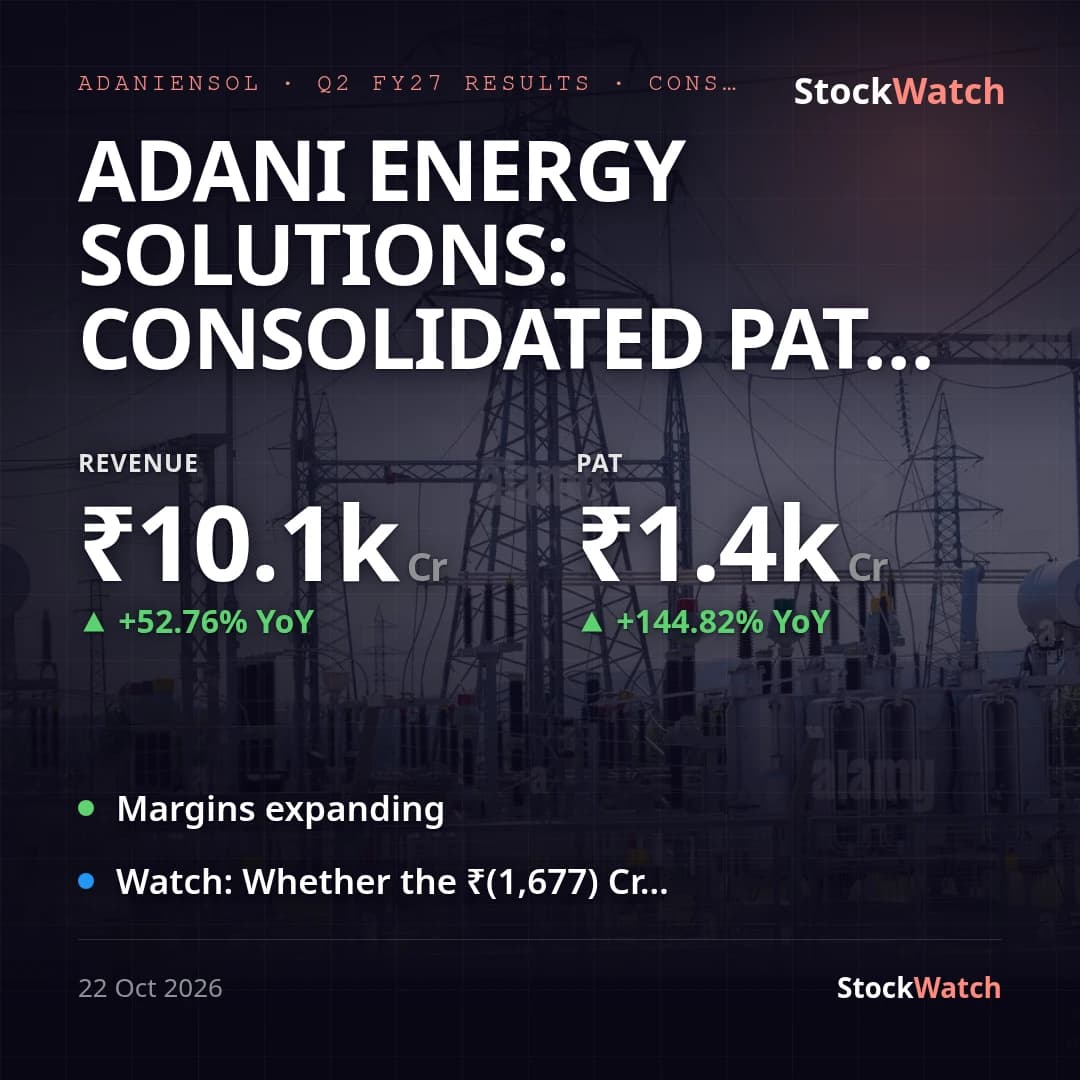
Adani Energy Solutions: consolidated PAT soars 145% YoY to ₹1,364 Cr as margins expand
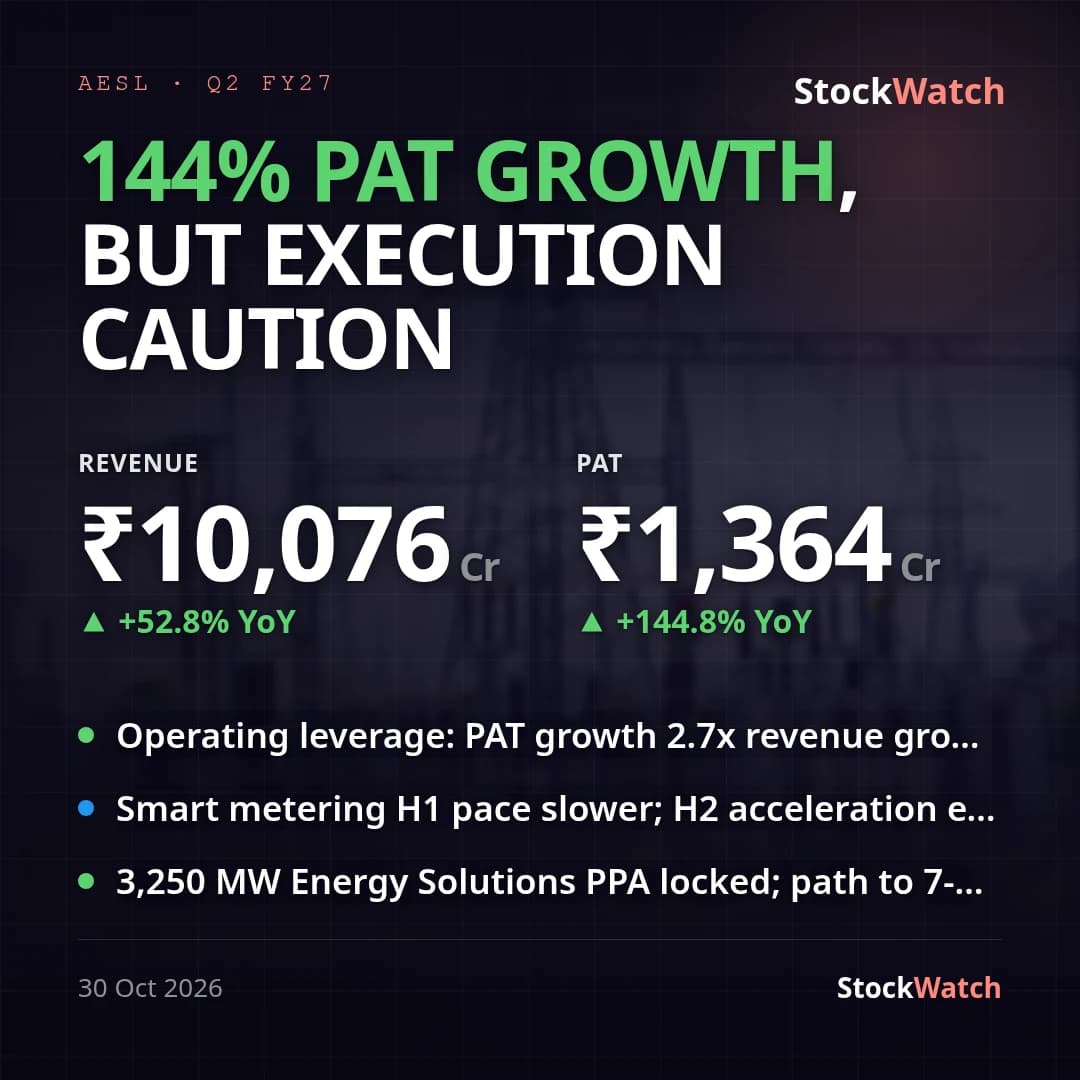
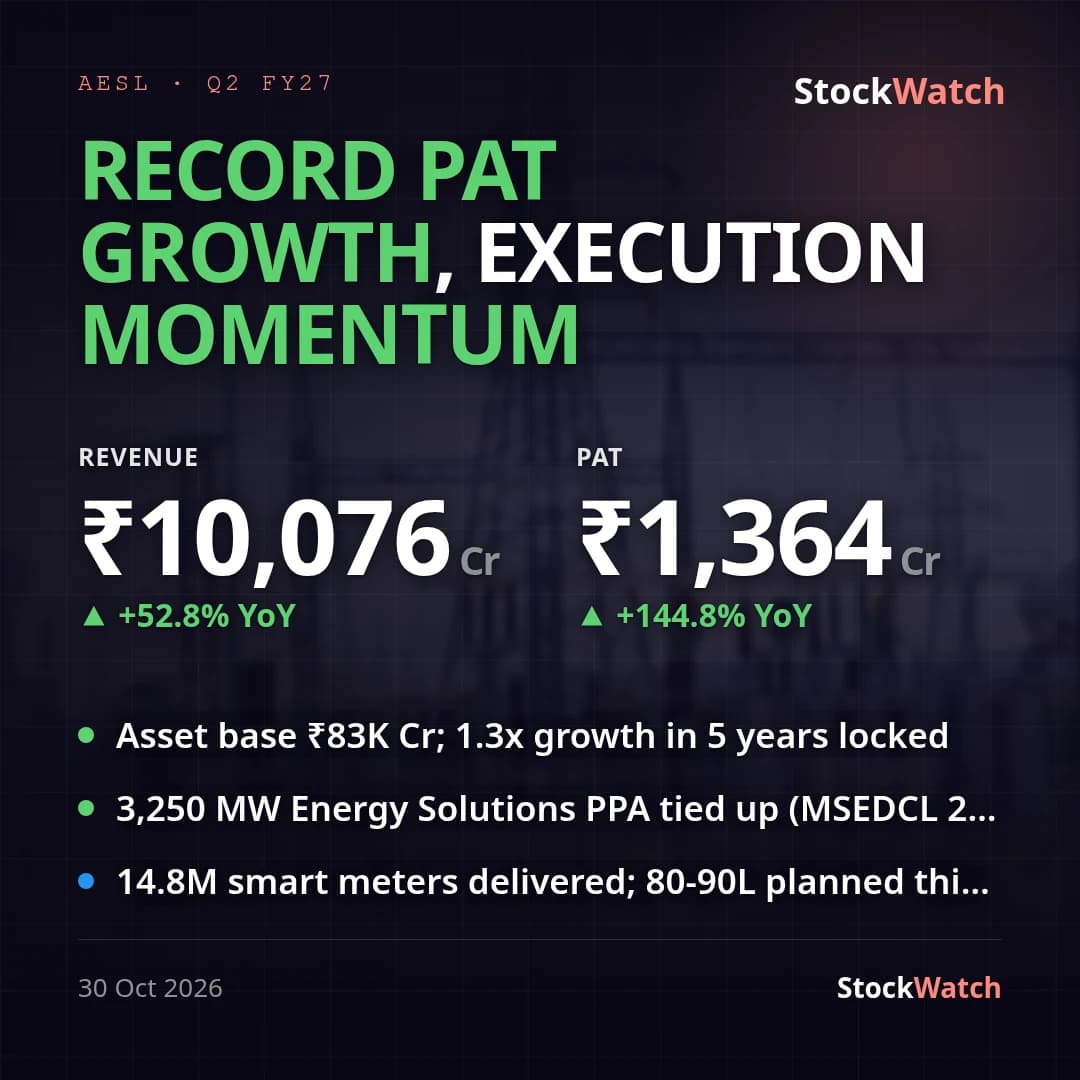
Adani Energy Solutions' consolidated numbers are the primary read since nearly all group operations sit in subsidiaries under the parent. Consolidated revenue was ₹10,075.54 Cr for Q2 FY27, up 52.8% year-on-year from ₹6,595.83 Cr (Q2 FY26) and 3.8% sequentially from ₹9,711.08 Cr (Q1 FY27). Consolidated PAT was ₹1,363.92 Cr (owners' share ₹1,322.85 Cr; non-controlling interests ₹41.07 Cr), up 144.8% YoY from ₹557.10 Cr and 10.3% QoQ from ₹1,236.56 Cr. Both disclosed margins expanded: net profit margin rose to 13.32% from 8.23% a year ago and 12.55% last quarter, and operating margin rose to 33.59% from 29.65% YoY and 31.27% QoQ. Basic EPS was ₹11.01 versus ₹4.44 a year ago and ₹9.57 last quarter. Standalone (parent-only) PAT fell 43.5% YoY to ₹57.29 Cr even as consolidated PAT rose 144.8% — an expected divergence given the parent is largely a holding entity, not a contradiction of the consolidated strength.
The growth is not evenly spread. Total segment PBIT rose ₹1,306 Cr YoY to ₹2,708.64 Cr, but roughly 60% of that increase (₹791 Cr) came from a single segment — the Energy Solutions Platform (the renamed former 'Trading' business) — whose PBIT jumped to ₹802.23 Cr from just ₹11.00 Cr a year ago on revenue up to ₹2,196.94 Cr from ₹200.61 Cr. The core regulated businesses grew more steadily: Transmission PBIT rose 26.2% YoY to ₹1,319.36 Cr on revenue up 51.7% to ₹3,598.71 Cr, and Distribution PBIT rose 42.4% YoY to ₹371.35 Cr on revenue up a modest 2.0% to ₹3,181.43 Cr. Working against the headline, a post-tax 'deferred assets recoverable/adjustable' charge of ₹(1,677.48) Cr hit the bottom line this quarter, sharply larger than ₹(48.57) Cr last quarter and just ₹(3.13) Cr a year ago, and not explained by name in the filing's notes. Pre-item profit was ₹3,041.40 Cr; the scale of this charge is unusual enough to flag even though the company does not label it exceptional.
No specific Street consensus for this quarter's revenue or PAT could be located; broker previews ahead of results flagged smart-meter deployment, transmission execution, EBITDA margins and QIP fund utilisation as watch items rather than publishing point estimates. Management's last guidance (July 2026 concall) was capex- and project-timeline based rather than quarterly-earnings based — ₹20-25K Cr annual transmission capex, 7.5 GW RTC energy-solutions capacity by 2031, HVDC commissioning at KPS-1 (Dec '29) and Rajasthan (early '29), and the IntelliSmart acquisition expanding the smart-metering order book to 4.7 Cr+ meters. On that basis the quarter is on-track: the IntelliSmart deal (₹3,050 Cr) remains pending CCI approval, unchanged from last quarter's disclosure, with no stated timeline slippage. The company completed its ₹3,500 Cr QIP in July 2026 at ₹1,615/share, which helped bring the consolidated debt-equity ratio down to 1.59x from 1.84x last quarter. Separately, the US DOJ/SEC matter against a non-executive director (not naming the company) was formally concluded this quarter with dismissal of all charges, and the company settled two minor SEBI proceedings (₹37.05 lakh and ₹9.75 lakh), neither with a P&L impact. No management press release was available in the materials reviewed to cross-check against these numbers.
Going into Q3 FY27, the key swing factors are whether the deferred-assets-recoverable charge normalises back toward the ₹(3)-₹(49) Cr range seen in the comparison quarters, whether the Energy Solutions Platform segment sustains anything close to this quarter's ₹802 Cr PBIT run-rate, and whether the IntelliSmart approval comes through to formally expand the smart-metering platform.