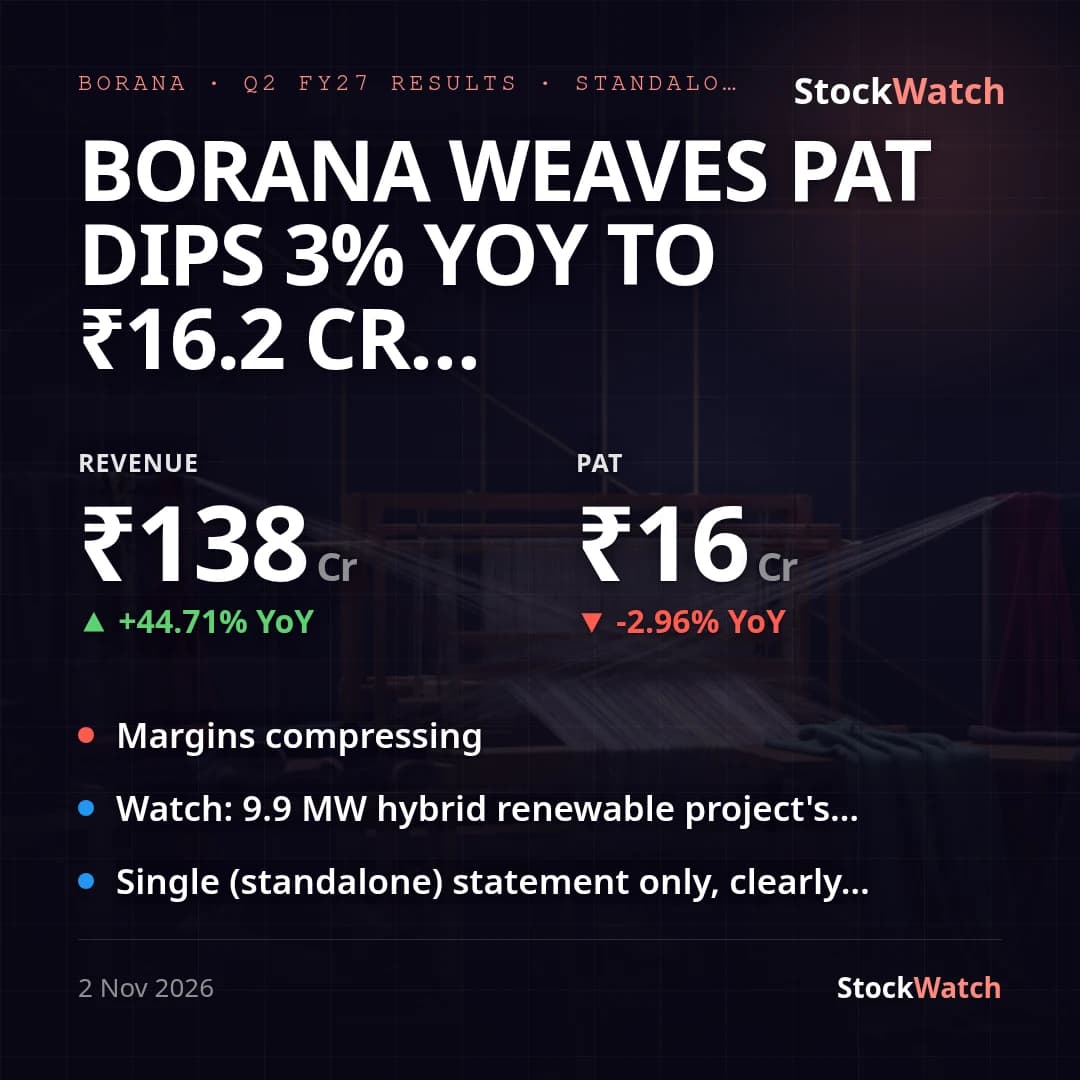
Borana Weaves PAT dips 3% YoY to ₹16.2 Cr as margins compress on 45% revenue growth
Borana Weaves' standalone revenue from operations rose 44.7% YoY (and 37.1% QoQ) to ₹138.20 Cr, but standalone PAT slipped 2.96% YoY to ₹16.16 Cr (-1.94% QoQ), with PBT down 3.6% YoY to ₹19.70 Cr — profitability declined on both the pre-tax and post-tax lines even as volumes scaled sharply. No prior-quarter or current-quarter exceptional item is reported, so the decline is purely operational rather than a one-off.
The squeeze shows up in the operating margin: OPM (EBITDA/revenue) fell to 19.16% this quarter from 22.68% a year ago and 25.63% last quarter, while net margin fell to 11.69% from 16.76% YoY. Cost of materials consumed rose to ₹88.58 Cr (64.1% of revenue, up from 58.6% a year ago), and employee costs (₹10.62 Cr, +62.6% YoY) and depreciation (₹6.10 Cr, +45.7% YoY) stepped up as new capacity came online ahead of matching revenue contribution.
This runs counter to management's own January 2026 guidance, which explicitly called for margin EXPANSION from favourable raw material pricing and ₹18-20 Cr of annual power-cost savings once new renewable capacity went live — instead margins compressed. The same results announcement also disclosed that the company's 9.9 MW hybrid renewable energy project has been delayed again, now targeted for March 2027, having already been pushed back once in a disclosure made just over a month earlier (September 30, 2026) — directly explaining why the guided power-cost relief has not yet materialised. No standalone management press release accompanied this filing, and no quarter-specific broker consensus could be confirmed via search, so street comparison is marked unknown rather than inferred.
On the revenue side, the capacity build-out is delivering: growth this quarter is broadly consistent with management's guided ₹60-75 Cr annual uplift from the 160 new looms added, part of the plan to double capacity to 2,000 looms by March 2028 on ₹350-400 Cr of capex. Margin recovery, however, is now contingent on the hybrid project's revised March 2027 timeline holding after two consecutive delays.