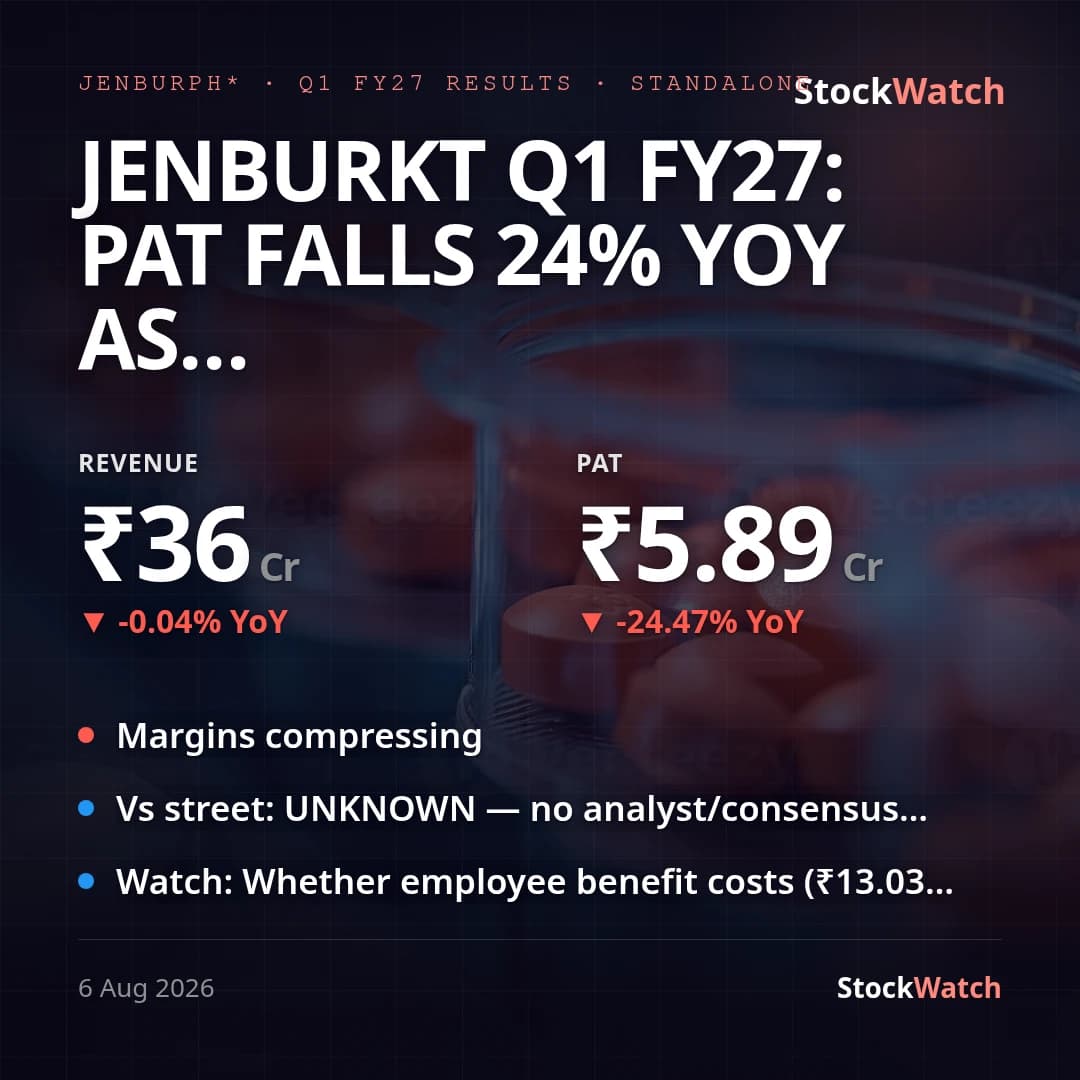
Jenburkt Pharmaceuticals' standalone PAT fell 24.5% YoY to ₹5.89 Cr (from ₹7.79 Cr) even as revenue from operations was effectively flat YoY at ₹35.51 Cr (-0.04%, from ₹35.53 Cr) — a pure margin story, not a demand one. Sequentially the decline is sharper (PAT -45.8% QoQ, revenue -20.4% QoQ) but that mostly reflects Q4 being the seasonally heavier, year-end quarter for the business rather than a fresh deterioration.
The squeeze sits almost entirely on the employee-cost line: employee benefit expenses rose to ₹13.03 Cr, up 11.1% YoY and a sharp 36.9% QoQ (from ₹9.52 Cr in Q4 FY26 and ₹11.72 Cr in Q1 FY26), pushing total expenses up 10.4% YoY to ₹30.26 Cr against near-flat revenue. Net profit margin compressed to 15.9% of total income from 20.7% a year ago and 22.2% last quarter; operating margin (PBT plus finance cost and depreciation, excluding other income, over revenue) fell to 17.0% from 25.2% YoY and 23.1% QoQ. EPS tracked the profit decline, at ₹13.34 versus ₹17.66 YoY and ₹24.58 QoQ, on an unchanged equity base of ₹4.41 Cr.
There is no consensus street estimate available for this print — Jenburkt is a micro-cap with no visible analyst coverage or published Q1 FY27 preview — so vsStreet is unknown rather than a genuine miss/beat. Management has issued no formal prior guidance or outlook on record, and no press release accompanying this result was available beyond the standard BSE outcome letter, so there is no management framing to reconcile against the numbers. Corporate developments this quarter are largely administrative rather than operational: the board fixed August 28, 2026 as the record date for the previously recommended ₹20.70/share FY26 dividend, submitted the FY26 annual report, and scheduled the 41st AGM for September 4, 2026; none of these bear directly on the quarter's operating performance.
On a full-year basis FY26 revenue had grown 13% and PAT 8.3%, so this quarter's flat topline and cost-driven profit decline is a step down from that run-rate — the key question going into Q2 FY27 is whether the employee-cost jump is a one-quarter step-up (increments, hiring) or a new higher base.