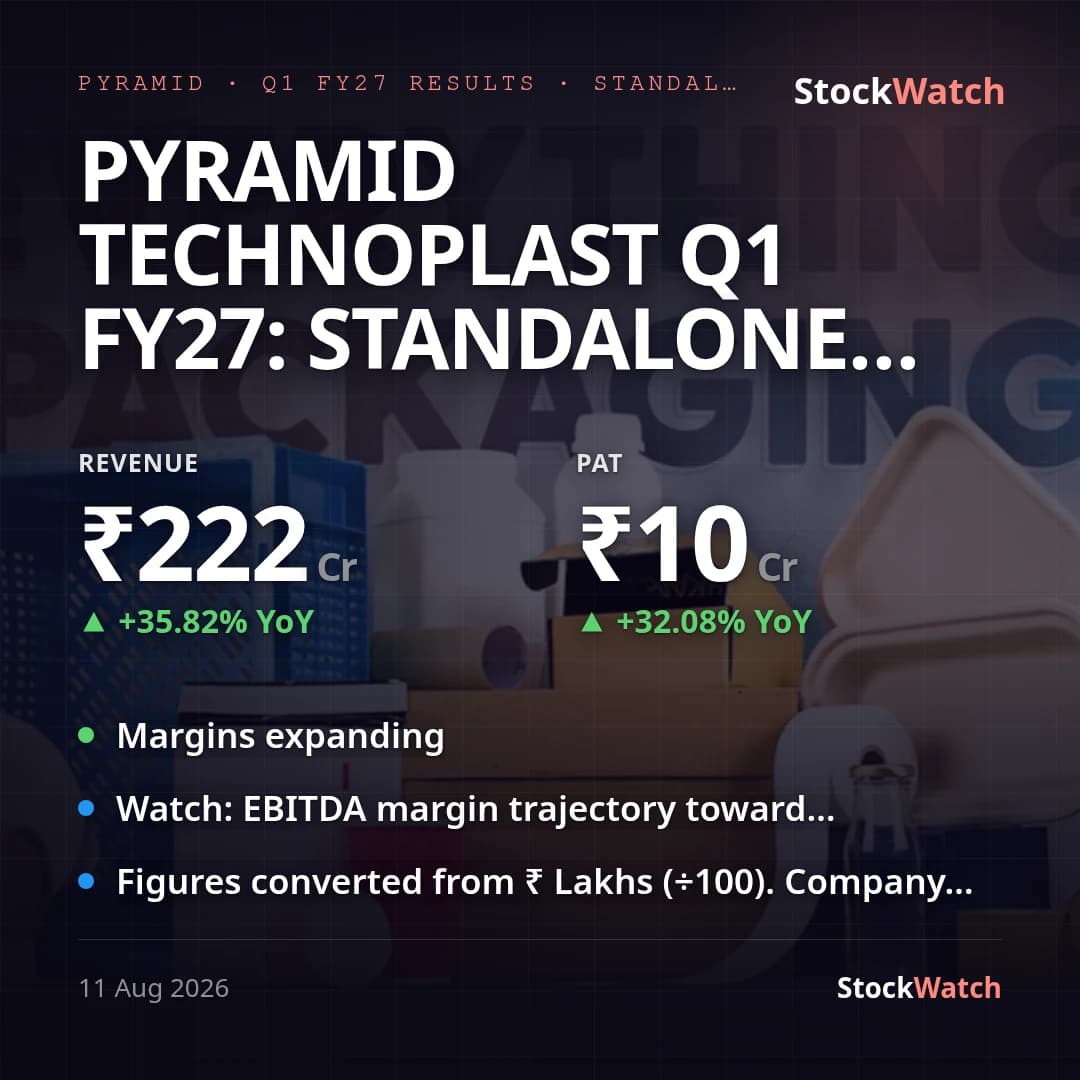
Pyramid Technoplast Q1 FY27: standalone PAT up 32% YoY as EBITDA margin expands, finance costs surge
Pyramid Technoplast's standalone Q1 FY27 (quarter ended June 30, 2026) revenue came in at ₹222.49 Cr, up 35.8% YoY (₹163.81 Cr) and 14.2% QoQ (₹194.79 Cr). PAT was ₹10.45 Cr, up 32.1% YoY (₹7.91 Cr) and 4.3% QoQ (₹10.02 Cr), with EPS of ₹2.85 (not annualised) versus ₹2.16 a year ago. Neither period carries exceptional items, so the growth is fully operational rather than one-off driven.
EBITDA margin (OPM) expanded to 9.11% from 8.14% a year ago — evidence of the operating leverage management had guided for as capex-led capacity comes online — but it slipped from 10.02% in the immediately preceding quarter. Net margin (NPM) was roughly flat YoY at 4.70% versus 4.80%, and down from 5.12% in Q4 FY26, because finance cost nearly tripled YoY to ₹3.51 Cr from ₹1.26 Cr (+178.9%) and depreciation rose 61.3% to ₹3.81 Cr from ₹2.36 Cr — both direct consequences of the major capex cycle the company had flagged as completing. Cost of materials consumed grew 40.1% YoY, outpacing revenue growth and also capping the margin improvement at the gross level.
Against management's FY27 guidance of ~₹800 Cr revenue and ₹75-80 Cr EBITDA (aiming for double-digit margins), Q1 is running ahead of pace: annualising the quarter implies ~₹890 Cr revenue and ~₹81 Cr EBITDA, already at the top of the guided EBITDA range, though the double-digit margin target itself (9.11% this quarter) hasn't been reached. No brokerage/street estimates specific to this quarter turned up in search — the stock does not appear to carry active analyst coverage, so vsStreet is unknown. The May 13, 2026 concall had guided to capacity utilization moving toward 80% and flagged an expected ₹15 Cr annual benefit from the new solar plant plus up to ₹5 Cr from the recycling facility; the sharp YoY rise in materials cost this quarter suggests those savings are not yet visibly reflected in the P&L.
Separately, the board used this meeting to approve Desai Saksena & Associates as incoming statutory auditor for a five-year term from the 28th AGM — a governance item unrelated to operating performance. Into Q2 FY27, the questions are whether EBITDA margin continues closing the gap to management's double-digit target and whether finance costs moderate now that the capex cycle is described as complete.