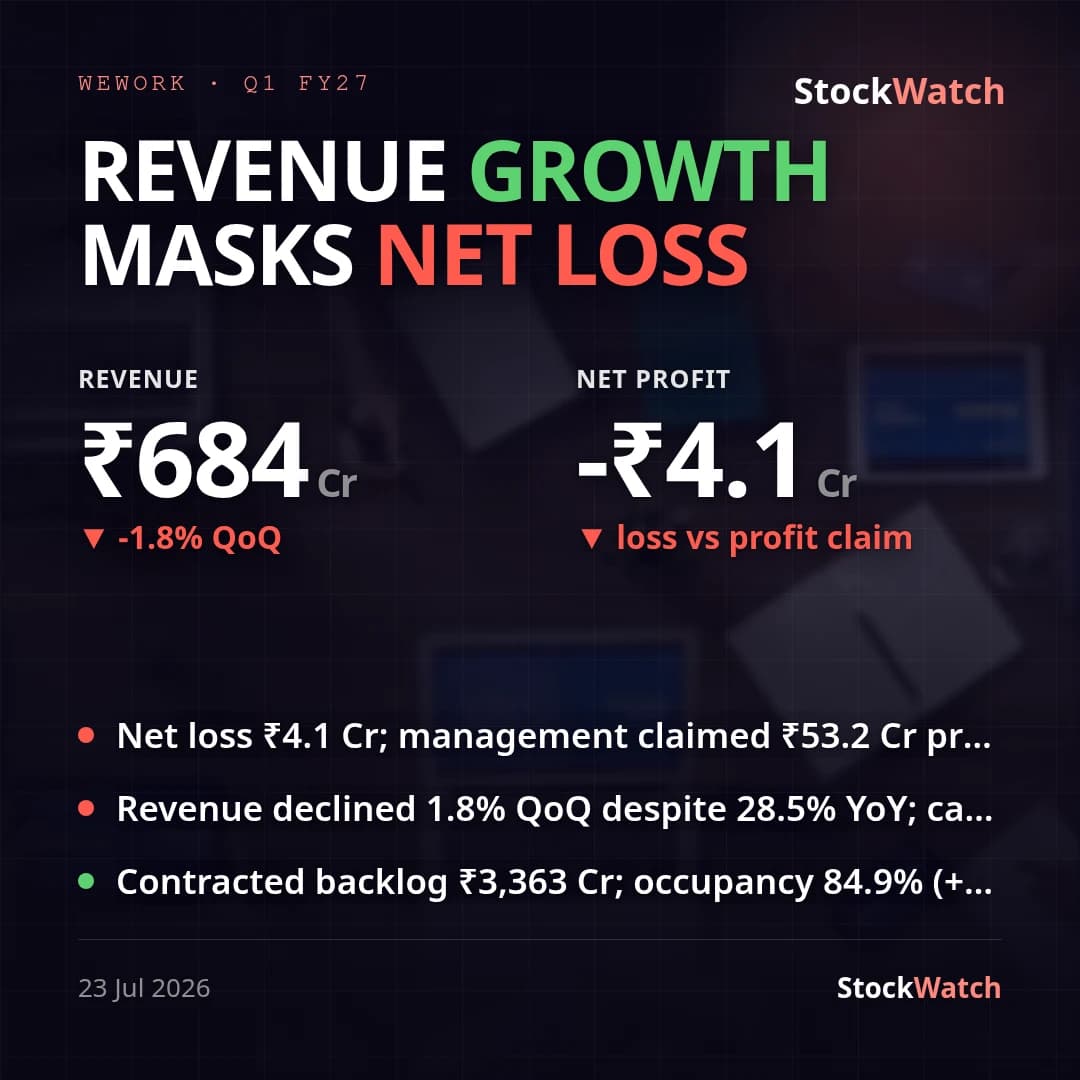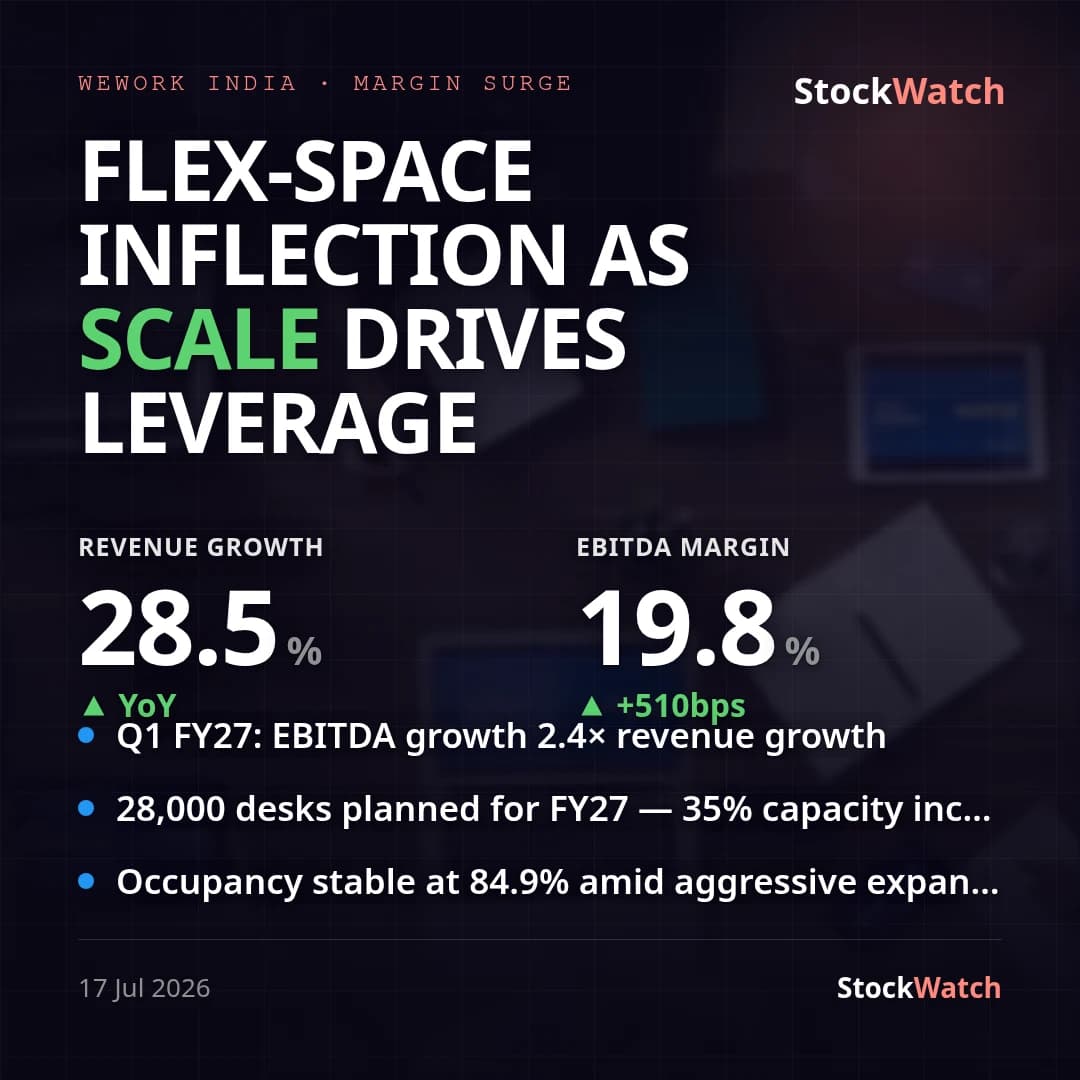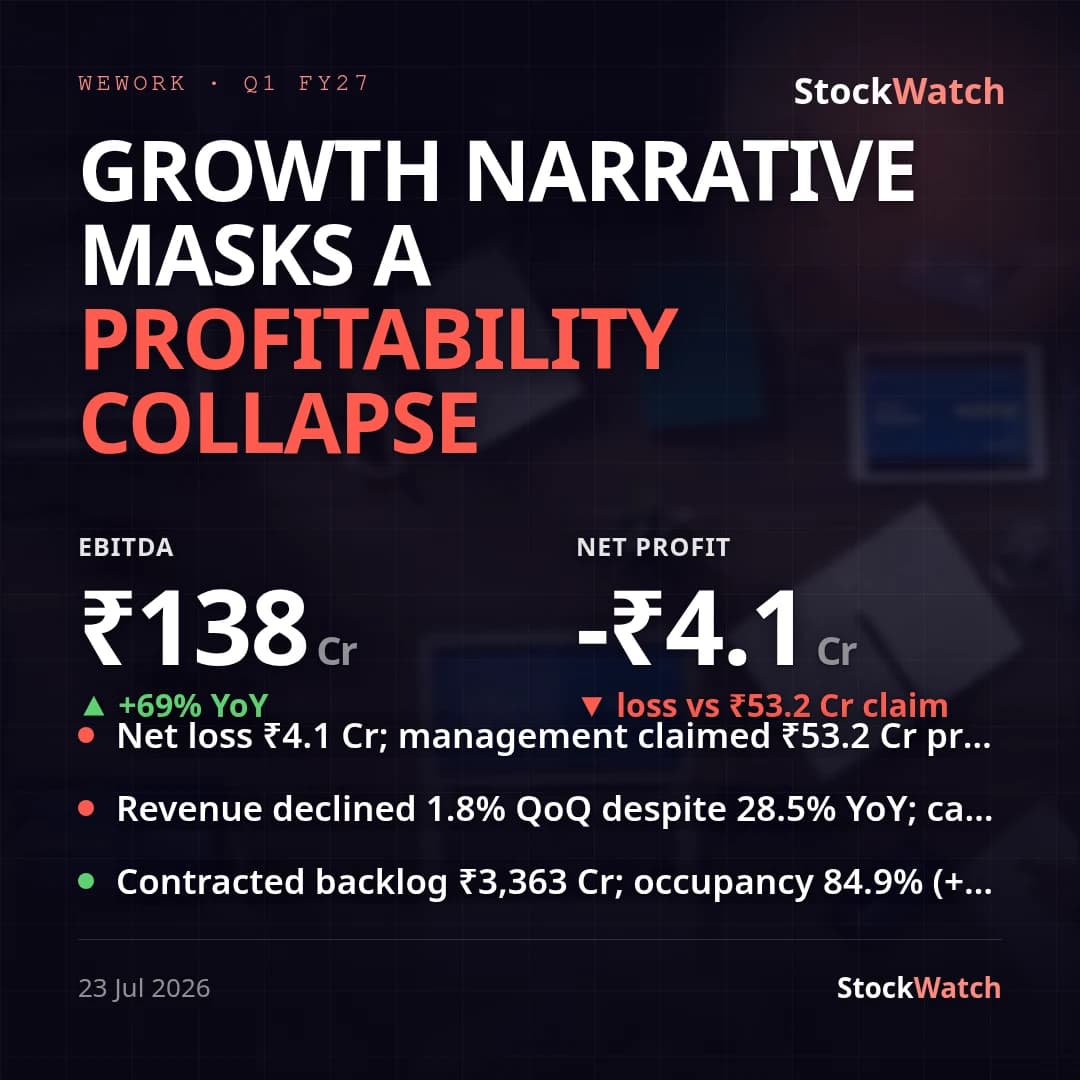
WeWork India reported consolidated revenue from operations of ₹683.8 Cr for Q1 FY27, up 27.7% year-on-year from ₹535.3 Cr, comfortably clearing management's stated >20% topline guidance. But the group slipped back to a net loss of ₹4.1 Cr (owners' share -₹4.3 Cr; EPS -₹0.31), versus a ₹65.9 Cr profit in the March quarter. That sequential swing overstates the deterioration: Q4 FY26's profit was inflated by a ₹22.1 Cr deferred-tax credit, so on a pre-tax basis the business went from +₹44.0 Cr to -₹3.9 Cr — a decline, but a far smaller one. Against the more meaningful year-ago comparison, the loss actually narrowed sharply, from ₹14.1 Cr to ₹4.1 Cr, as the company converges toward net breakeven.
The loss is structural, not operational. Operating (lease-adjusted EBITDA) margins remained strong at roughly 66% of revenue, up modestly from ~64.7% a quarter ago — the gap to a net loss is entirely the Ind AS 116 stack of depreciation (₹282.8 Cr, +5.9% QoQ) and finance costs (₹176.1 Cr, +10.6% QoQ) that expansion front-loads ahead of revenue ramp. Employee costs also rose 14% QoQ to ₹58.3 Cr. This is the arithmetic of the growth plan management flagged on the Q4 concall: ₹500-600 Cr of FY27 capex and continued capacity additions (including the 31,259 sq ft Hyderabad lease taken during the quarter and ~14,000 desks slated for the period) show up as depreciation and finance charges before the new inventory fills.
The print therefore confirms the top-line guidance but sits at odds, for now, with management's Q4 claim of earnings compounding faster than revenue — the bottom line is negative, even if the YoY trajectory is toward profit. No formal quarterly consensus exists for this October-2025 IPO, so there is no street bar to beat or miss. Alongside the results the board approved three capital-structure actions — reclassifying the ₹1,000 Cr authorised capital to all-equity (retiring the CCPS class), and a securities-premium reduction to write off ₹2,050.2 Cr of accumulated losses against the ₹2,159.0 Cr premium balance — housekeeping that cleans up the balance sheet without any cash or shareholding impact, and signals intent to present a profitable book once operations turn.