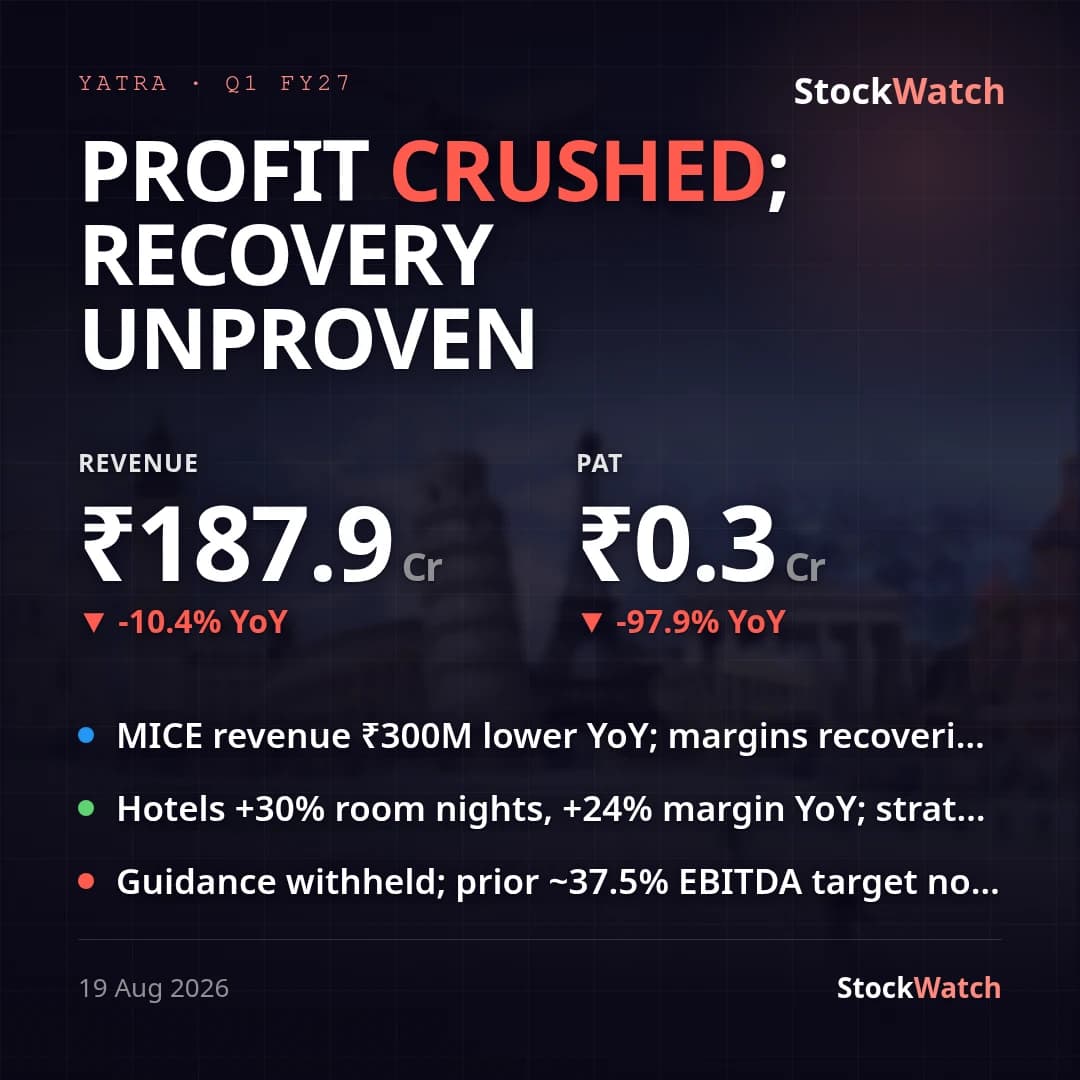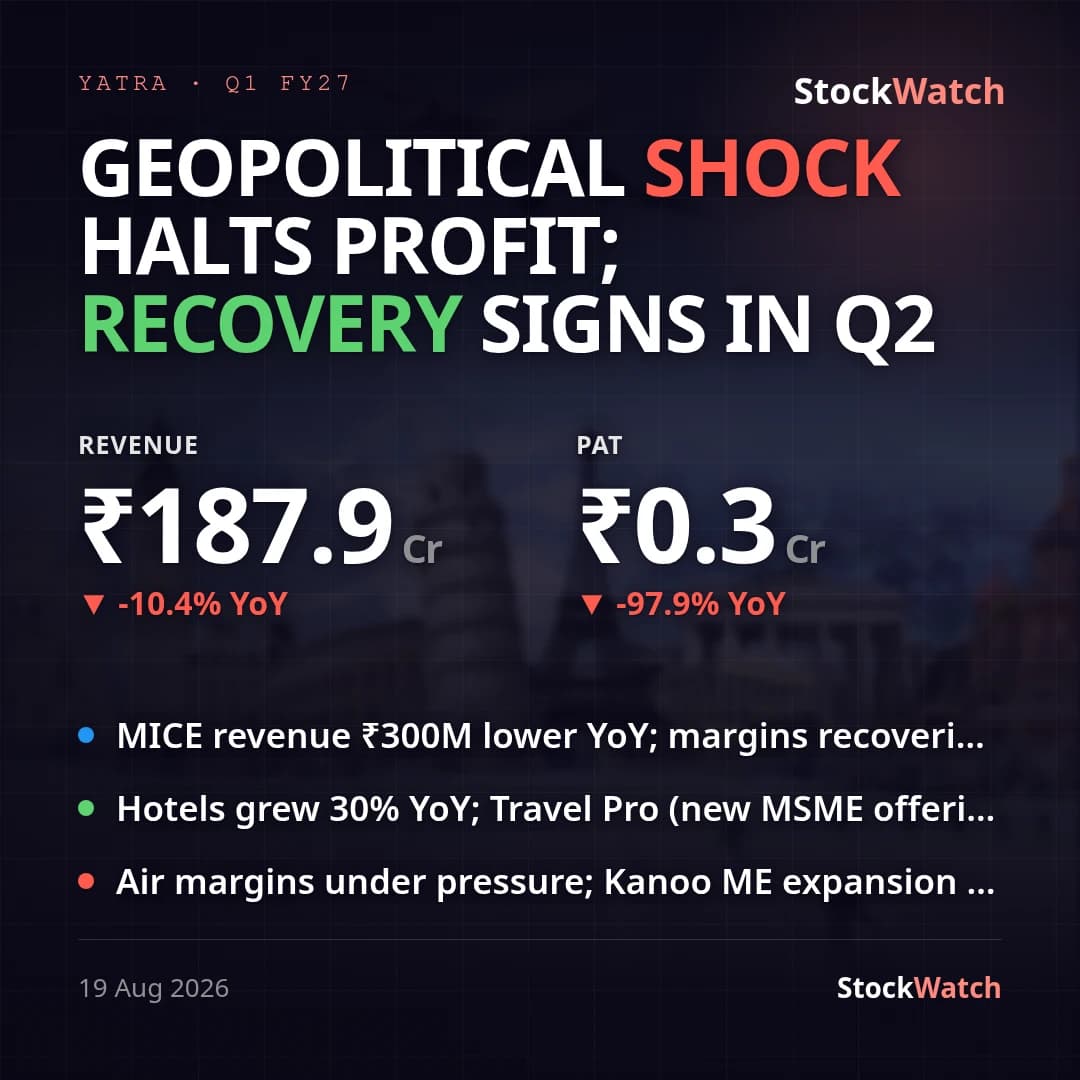
Yatra Online's consolidated PAT for Q1 FY27 (quarter ended June 30, 2026) fell to just ₹0.34 Cr from ₹16.0 Cr a year ago (-97.9% YoY) and ₹8.2 Cr last quarter (-95.9% QoQ), even as revenue declined 10.5% YoY to ₹187.9 Cr (down marginally 0.6% QoQ from ₹189.0 Cr). The company stayed narrowly profitable rather than swinging to a loss, but net margin was crushed to 0.18% from 7.43% a year ago and 4.11% last quarter — a near-total wipeout of bottom-line profitability on a comparatively modest topline decline. No exceptional items featured in either this quarter or the year-ago quarter, so the fall is operational, not accounting noise.
The squeeze shows up broadly across the cost base: employee benefit expenses, marketing spend, depreciation and finance costs all rose in absolute terms even as revenue fell, while the segment-level "adjusted margin" (revenue-less-service-cost, the metric management guides on) actually declined 7.75% YoY to ₹121.0 Cr. That is a clear miss against the ~20-22% revenue-less-service-cost growth and ~37.5% adjusted-EBITDA growth guidance management reaffirmed as recently as its Q3 FY26 (February 2026) call, where tone was described as confident and bullish — this print directly contradicts that framing rather than confirming it. Standalone results tell a materially milder story: standalone PAT of ₹6.28 Cr (EPS ₹0.40) was down 48.7% YoY, a much smaller decline than the consolidated 97.9% YoY drop, pointing to subsidiary-level costs or losses (TSI Yatra, Globe All India Services, Yatra MICE and Holiday, and Yatra Middle East LLC-FZ) as the primary driver of the group-level collapse.
No management press release accompanied this filing and no specific Street consensus estimate for this quarter's revenue or PAT could be located, so the print cannot be benchmarked against analyst expectations here. Among this quarter's other developments, the company signed an MoU with Kanoo Travel on July 13, 2026 for Middle East expansion — routed through the Yatra Middle East LLC-FZ subsidiary that sits inside the consolidated numbers — a growth investment that may partly explain rising consolidated costs even as the standalone entity held up better. The board also re-appointed Ernst & Young LLP as internal auditor for FY27, a procedural item with no bearing on the results.
Going into Q2 FY27, the guidance miss on both revenue-less-service-cost and adjusted EBITDA growth, plus the standalone-consolidated divergence, are the two threads to track — whether subsidiary costs normalize and whether the medium-term growth targets management has repeatedly reaffirmed start showing up in the numbers again.