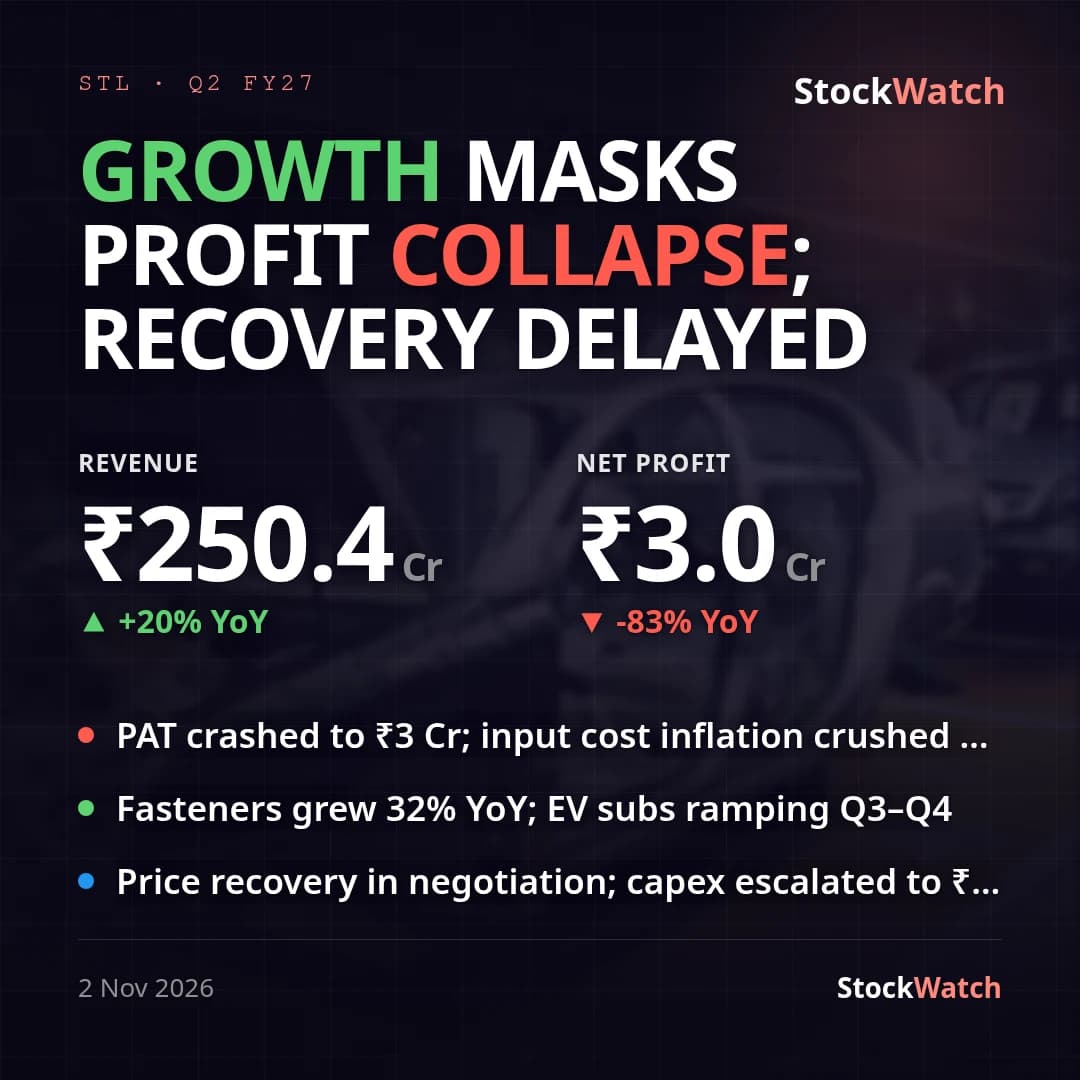
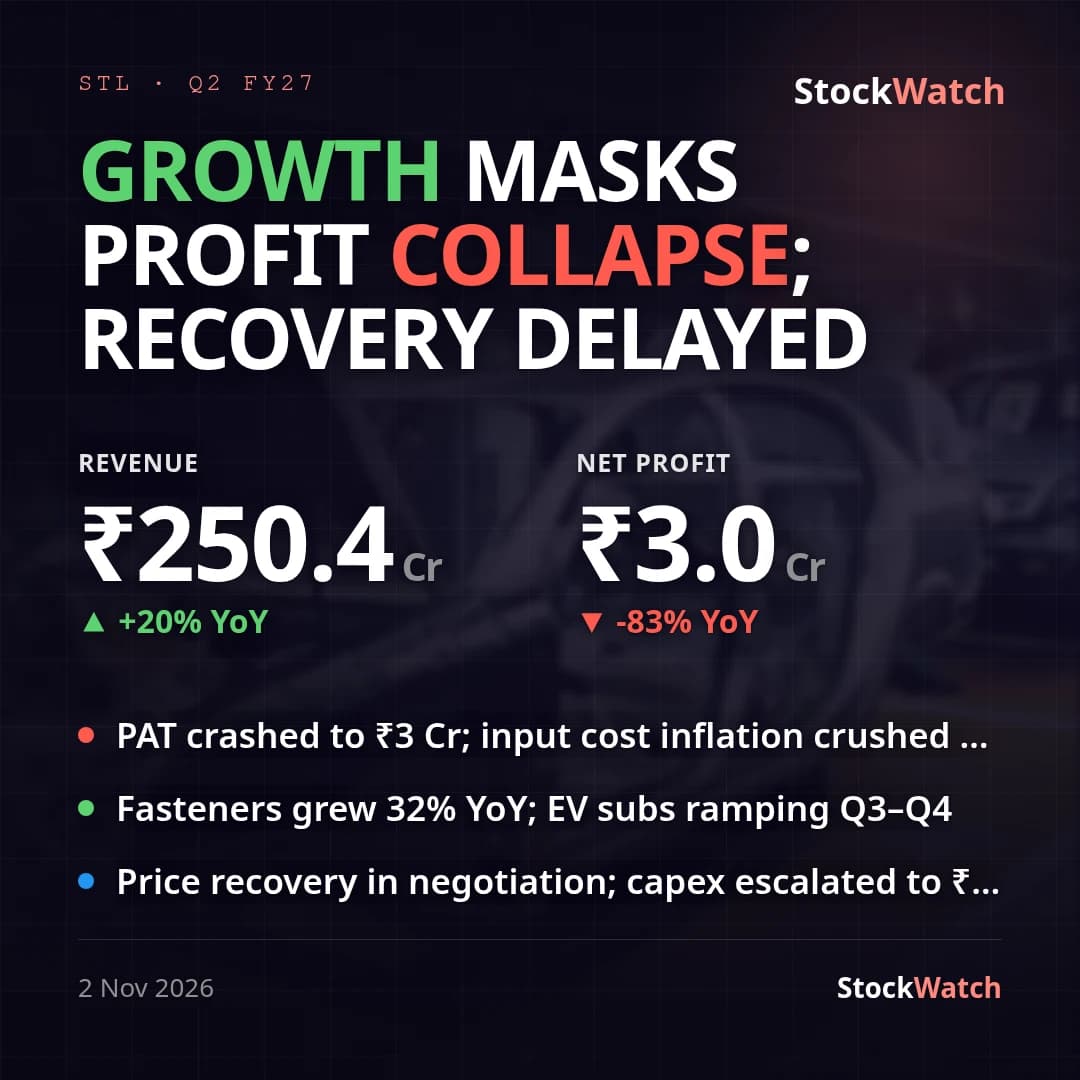
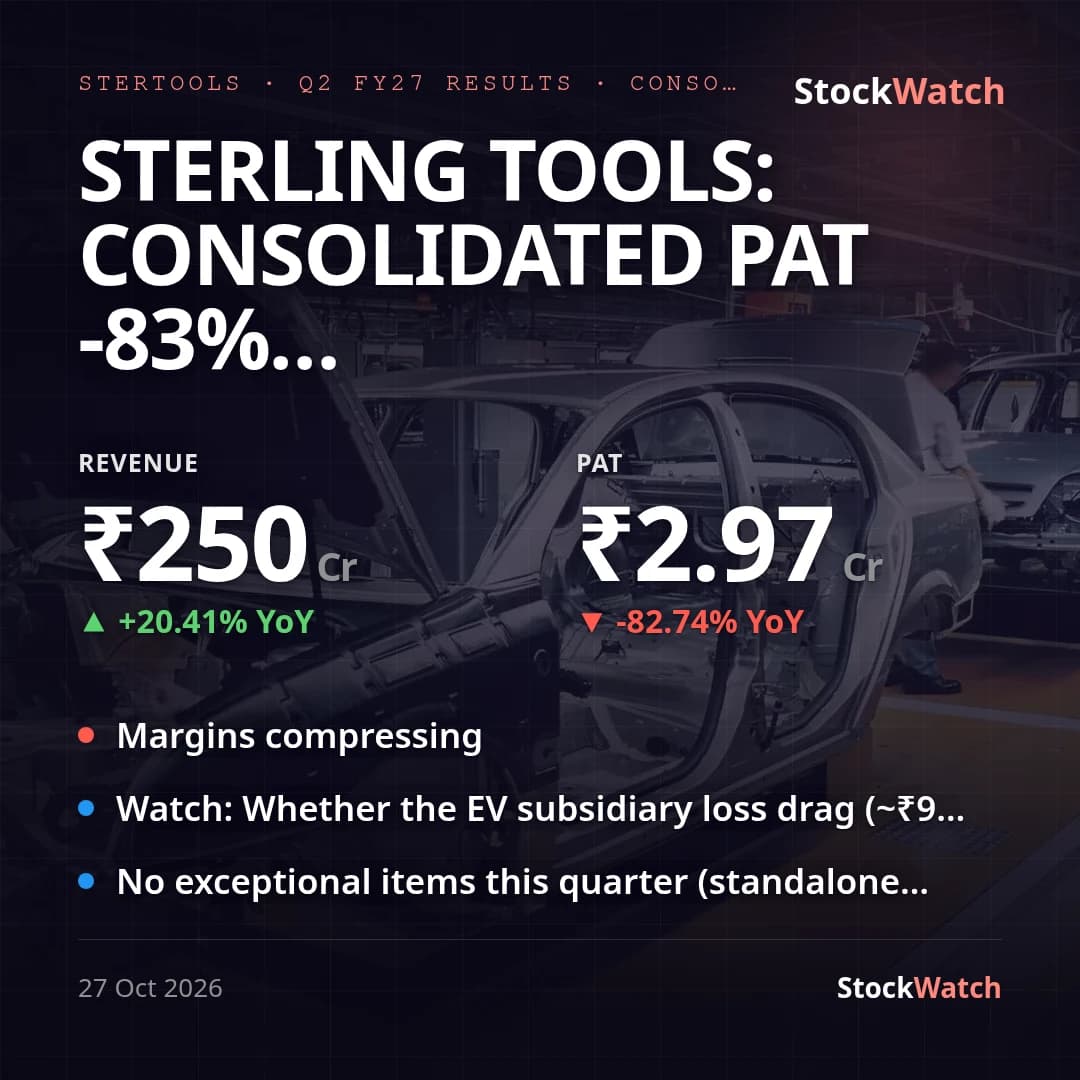
Sterling Tools' consolidated revenue rose 20.4% YoY and 17.0% QoQ to ₹250.35 Cr, but consolidated PAT fell to just ₹2.97 Cr — down 82.7% YoY and 49.4% QoQ. The YoY comparison is flattered on the downside by a one-off: the year-ago quarter's ₹17.19 Cr PAT included a ₹9.50 Cr non-recurring DMRC land-compensation gain (nil this quarter), so the adjusted YoY PAT decline is a still-steep ~61%. The company remains profitable, not loss-making, but the magnitude of the drop is the story.
The margin bridge has two layers. First, the standalone fasteners business — the core, profitable engine — grew revenue 32.9% YoY to ₹225.89 Cr and posted PAT of ₹13.63 Cr (NPM 6.0%), comfortably ahead of management's 20%+ annual fastener-growth guidance from the August 2026 concall. But even standalone operating margin eased to 11.3% from ~13.7% YoY and ~14.3% QoQ, as cost of materials consumed rose to 42.4% of standalone revenue from 37.4% a year ago. Second, and larger, is the subsidiary drag: standalone PBT of ₹17.69 Cr against consolidated PBT of only ₹8.69 Cr implies a ~₹9.00 Cr quarterly loss drag from the EV subsidiaries (Sterling E-Mobility Solutions, Sterling Advanced Electric Machines, Sterling Tech-Mobility) — versus a comparable ~₹9.10 Cr drag last quarter but just ~₹2.18 Cr a year ago (ex-exceptional). Consolidated OPM compressed to 7.9% from 15.9% YoY/10.6% QoQ, and NPM to 1.2% from 8.2% YoY/2.7% QoQ.
No formal brokerage consensus for this specific quarter turned up in search, reflecting thin analyst coverage of the stock; a Q1 FY27 read from MarketsMojo flagged the same EV-loss-driven margin pressure, consistent with this quarter's pattern. Against management's own FY27 guidance — fasteners 20%+ growth (beaten), EV businesses 20–30% growth and a combined FY28 breakeven at ₹225–250 Cr revenue — the widened loss run-rate this quarter sits uncomfortably against that breakeven trajectory; the filing carries no management press release or commentary to explain the subsidiary-level drivers beyond the numbers. Capex continued regardless: standalone CWIP rose to ₹9.78 Cr from ₹2.91 Cr at FY26-end (fastener capacity push toward ₹1,000 Cr), and the parent infused a further ₹39.93 Cr into subsidiaries in H1 FY27. Separately, the same filing disclosed a CFO transition — Anish Agarwal resigned effective 26 October 2026 (continuing as Whole-time Director), succeeded by Amit Dhadda, a 25+-year finance veteran from Minda Corporation, Paytm, PwC and Deloitte, effective 27 October 2026.
Going into Q3 FY27, the two things to track are whether the EV subsidiary loss drag (~₹9 Cr/quarter now) narrows toward the FY28 combined-breakeven path, and whether standalone OPM recovers from its slip to 11.3% as material-cost pressure either persists or eases.