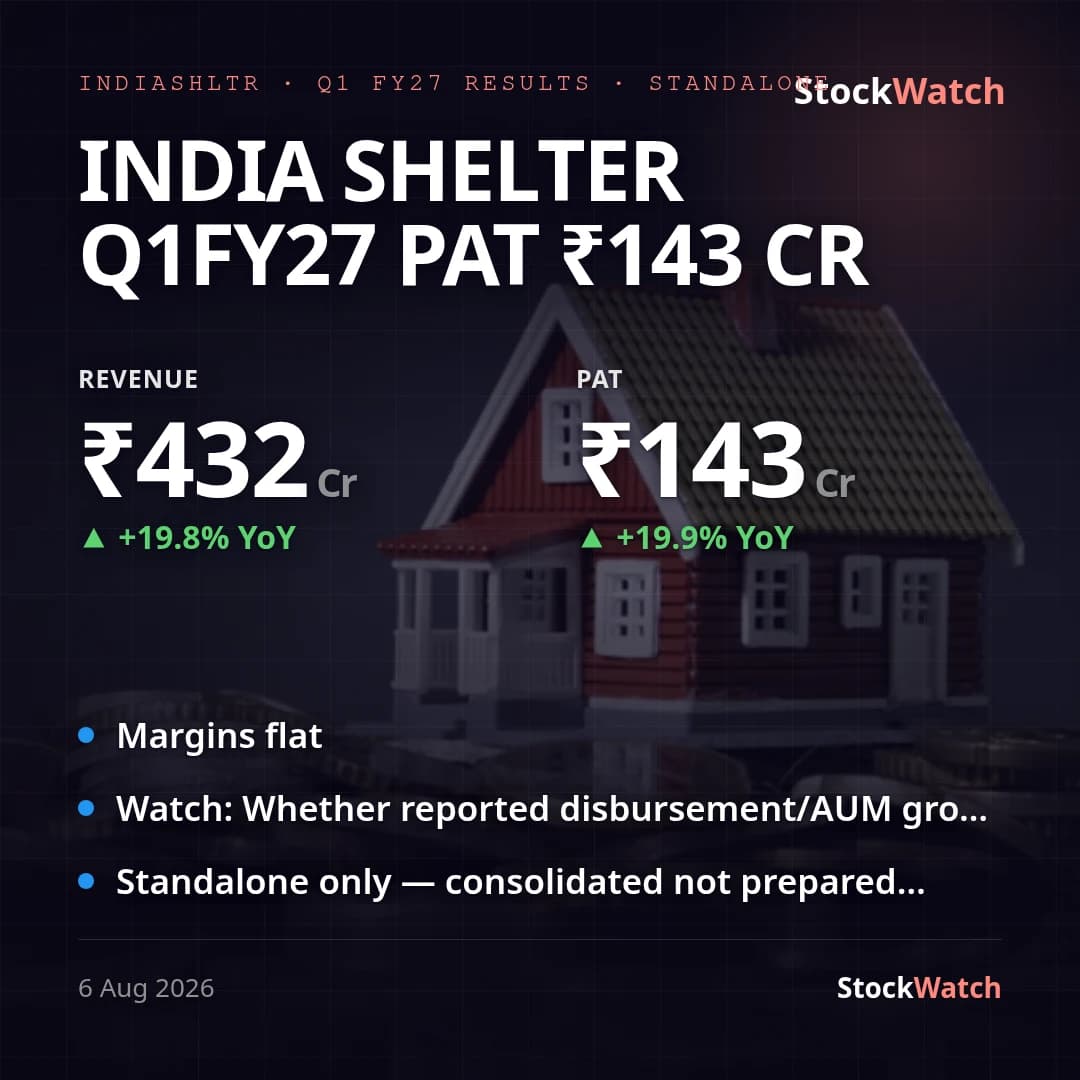
India Shelter Q1FY27 PAT ₹143 Cr, up ~20% YoY; margins steady, AUM growth in line
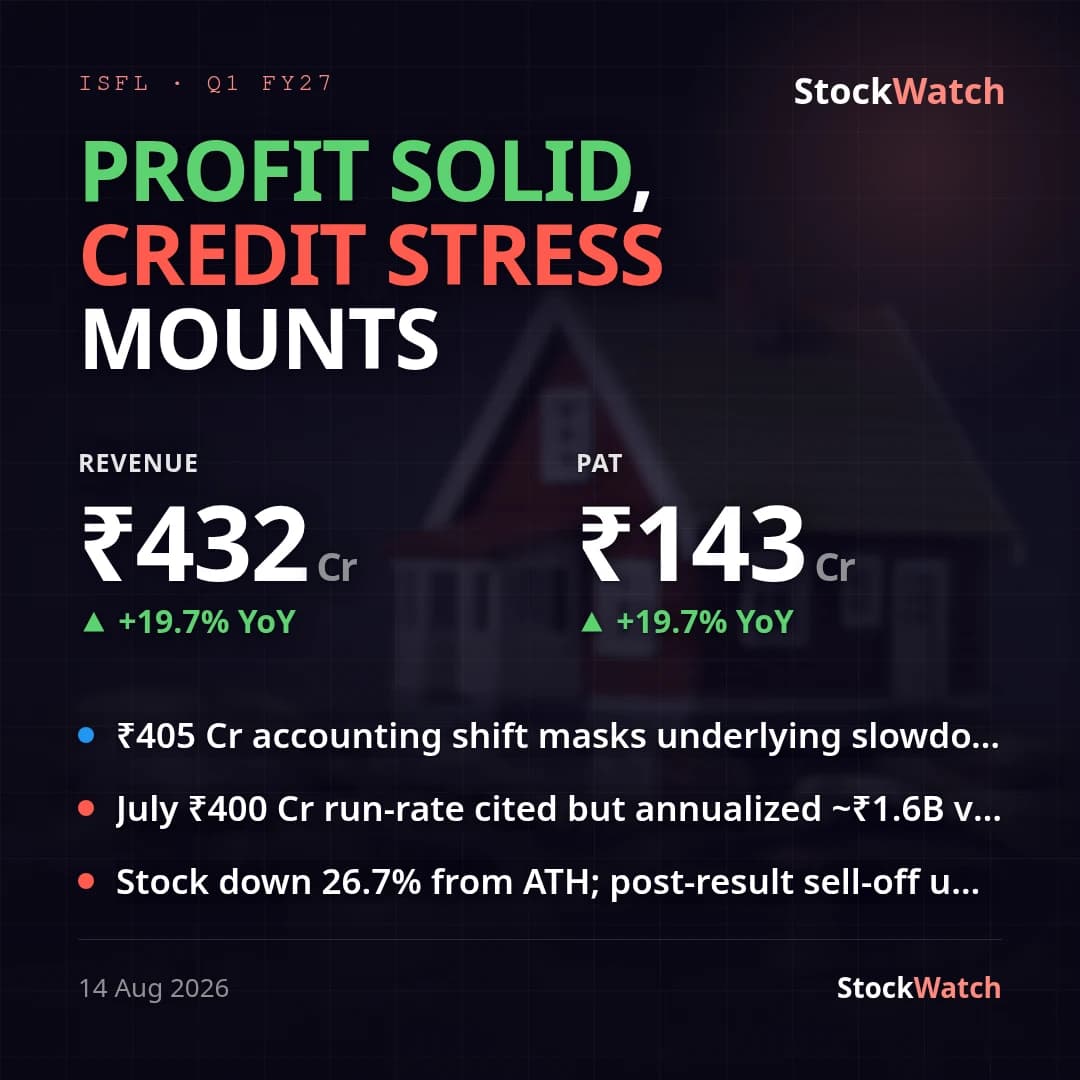
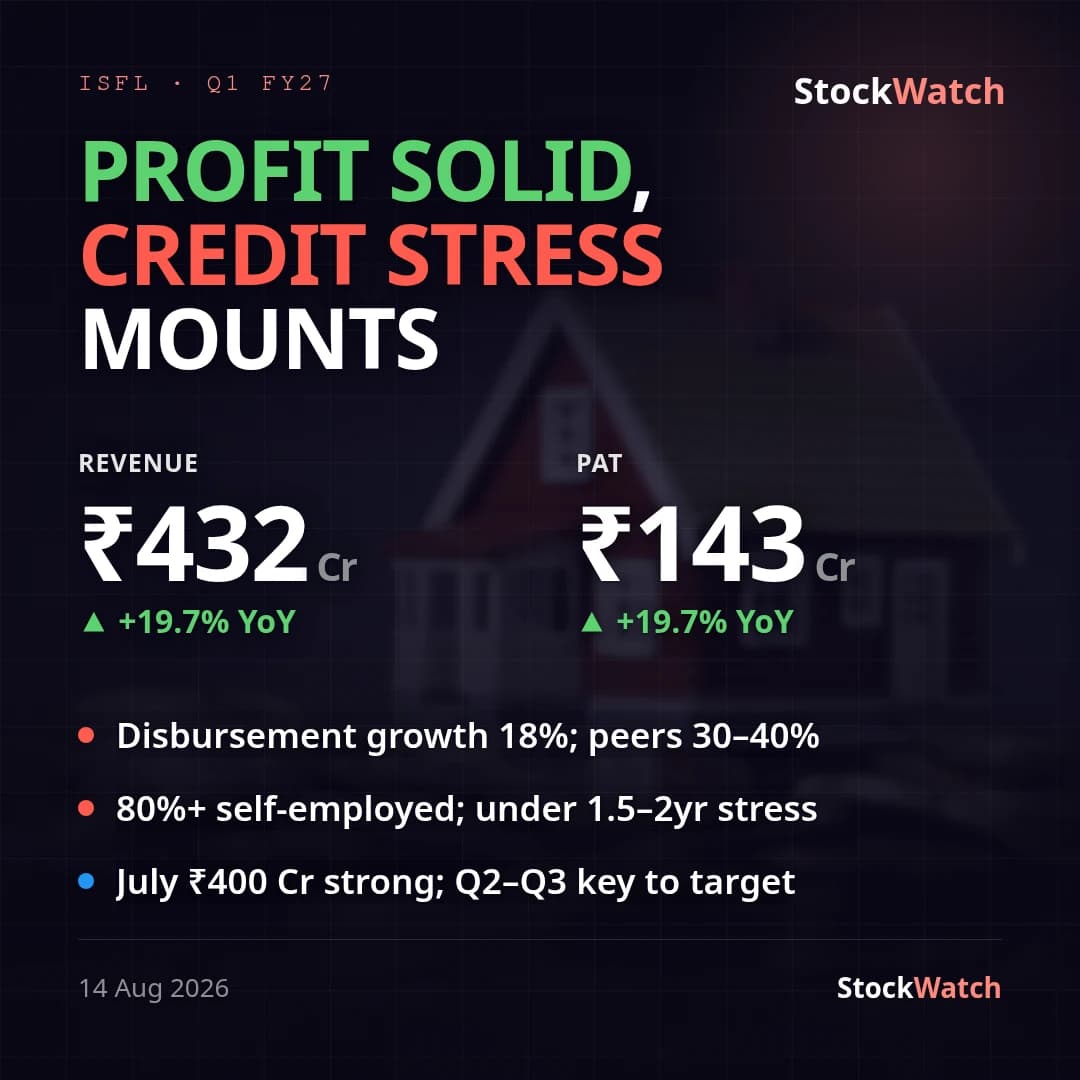
India Shelter Finance's standalone PAT came in at ₹143.02 Cr for Q1 FY27, up 19.9% YoY from ₹119.23 Cr and up 2.1% QoQ from ₹140.06 Cr (audit committee/board approved 6-Aug-2026, limited-review opinion from S.R. Batliboi & Associates). Revenue from operations rose 19.8% YoY to ₹432.39 Cr (+5.3% QoQ), and profit growth tracked revenue growth almost one-for-one, so this is a steady, unremarkable-in-a-good-way quarter rather than a beat or a miss — there is no quarter-specific street PAT estimate on record to grade against (a web check found only a full-year FY27 consensus profit-growth estimate of ~23%, itself just above this quarter's YoY pace), so vsStreet is marked unknown rather than guessed.
Margins were essentially flat: the company's own disclosed Net Profit Margin was 33.07% versus 33.06% a year ago, though it eased from 33.70% in the March-2026 quarter — a modest sequential moderation rather than a trend. Finance costs rose to ₹121.12 Cr (up from ₹106.46 Cr YoY) as the balance sheet grew, while impairment/credit cost of ₹13.41 Cr for the quarter annualises to roughly 47-48 bps of the ₹11,284 Cr Gross AUM reported by management — inside the 40-50 bps credit-cost band the company guided to on the Q4 FY26 call, and asset quality actually improved sequentially (Gross NPA 1.55%, Net NPA 1.15%, Stage-3 provision coverage 25.72% as of 30-Jun-2026).
On guidance, management's May-2026 call had targeted 25-30% AUM growth over three years toward a ₹30,000 Cr AUM goal by 2030, with spreads above 6%. Gross AUM grew 24% YoY to ₹11,284 Cr per the company's own press release — just shy of the low end of the guided band, so this reads as broadly on-track rather than a clean beat. During the quarter the company also allotted ₹75 Cr of NCDs (approved as a ₹100 Cr issuance on 20-Jul-2026) and continues to maintain 110% security cover on its secured listed NCDs, both routine funding-side developments consistent with the growth plan rather than signals in themselves. Management's own framing called FY27 'a steady note' and was explicit that the cheque-realisation accounting change — not demand or credit softness — is what temporarily depressed reported disbursement optics this quarter; the P&L itself shows no exceptional item and both internal arithmetic checks (total income, PBT-minus-tax) tie out exactly, supporting that read.
Going into Q2, the key things to reconcile are whether the disbursement/AUM growth rate normalises back toward the 25-30% guided band once the recognition-timing effect washes through, and whether credit costs hold inside the 40-50 bps band as the ₹75-100 Cr of fresh NCD funding is deployed.